

Practicing RRB JE Previous Year Papers is one of the best ways to prepare for the Railway Junior Engineer examination. While the syllabus mentions what the candidates need to study and the exam pattern lays down the manner in which the examination is conducted, previous year papers give an insight into how questions are actually framed. They help aspirants to know the difficulty level, objective question style, subject coverage, and overall approach to perform well in the examination.
Many candidates study textbooks and make notes for months, but they underestimate the importance of solving previous question papers. Though conceptual learning still remains the bedrock of preparation, application of those concepts in real examination questions goes a long way in boosting confidence and examination preparedness. Previous year papers expose the candidates to real examination scenarios and help them understand how the theoretical knowledge is tested under time constraints. It is highly recommended that you practice previous papers on a regular basis as it helps in improving speed, accuracy, and familiarity with exam trends.
Previous year papers are not like normal practice questions; they are as per the actual examination standards. They assist candidates to evaluate if their preparation is in accordance with the actual needs of the Railway Recruitment Board. This makes them an invaluable resource at all stages of preparation.
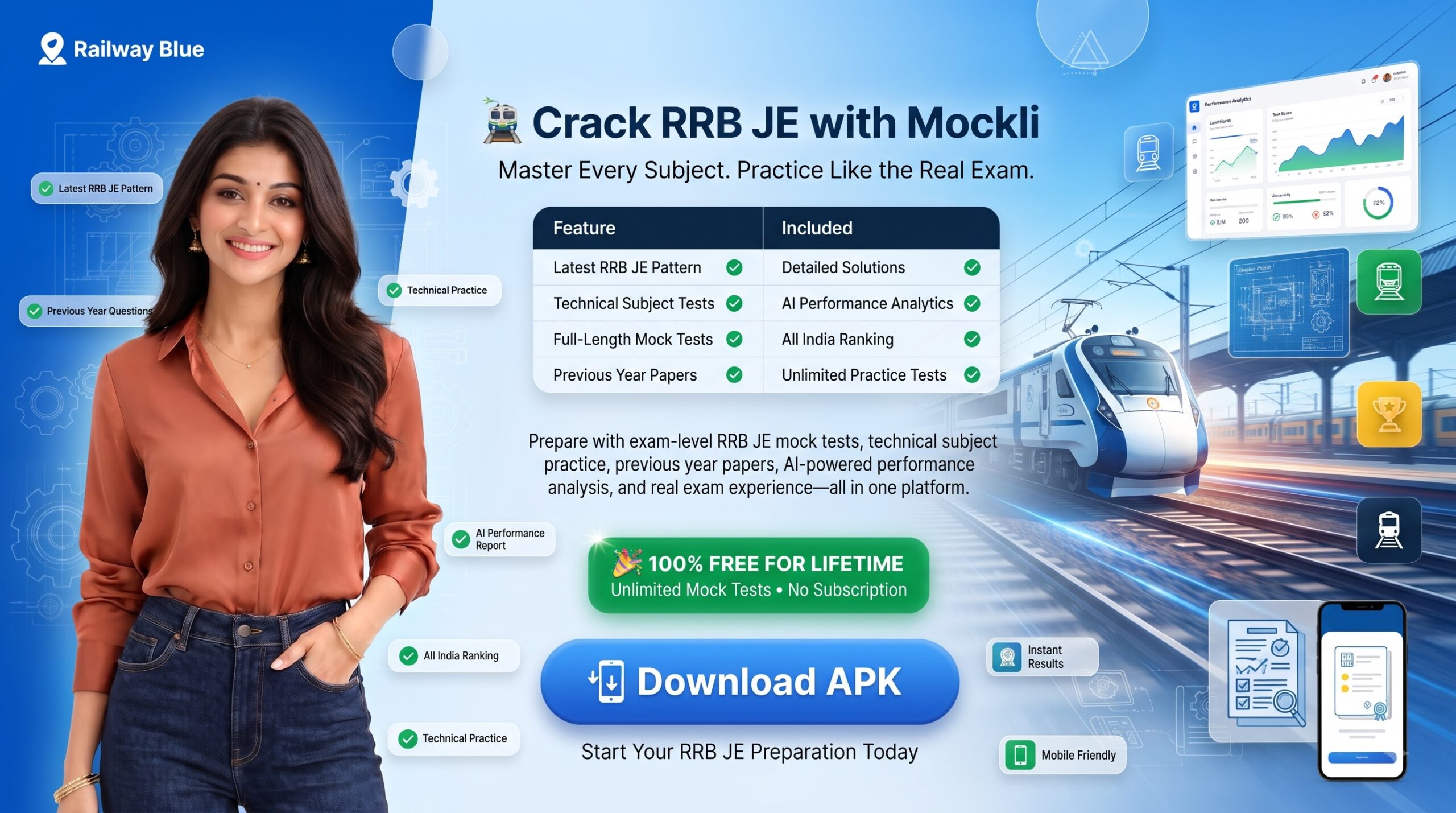
Mockli empowers the candidate to practice RRB JE Previous Year Papers, RRB JE Eligibility, RRB JE Salary, Free RRB JE Mock Tests, RRB JE Selection Process, RRB JE Cut Off, RRB JE Job Profile, RRB JE Medical Standard, and topic-wise questions, along with in-depth performance analytics to build conceptual understanding and exam writing skills systematically.
What Are RRB JE Previous Year Papers?
RRB JE Previous Year Papers are the real question papers that have been asked in the RRB JE exams in the previous years. These papers are segregated into aptitude-based and technical sections according to the stage of the examination and give the candidates a valuable insight into the overall structure of the examination.
Model papers are made for practice, while previous year papers are set on the actual difficulty level faced by the candidates in the actual examination. These papers assist aspirants to know the framing of questions, conceptual depth, and balance between theoretical and application-based questions.
There is also an indication in previous papers of the contribution of different subjects to the overall examination. Based on the examination stage, candidates come to know the distribution of questions related to Mathematics, General Intelligence and Reasoning, General Science, General Awareness, Computer Applications, Environment and Technical Engineering. Also helpful for recognizing common concepts and question formats in both CBT 1 and CBT 2.
It is important to practice regularly on actual papers to fill the gap between classroom learning and actual examination performance.
Why Every RRB JE Aspirant Should Solve Previous Year Papers
One of the biggest advantages of previous year papers is that it helps the candidates prepare as per the actual examination standards and not assumptions. Many hopefuls study hard, but do not know what type of questions will be asked. This is where previous papers come in and take away the uncertainty by exposing you to real examination questions.
An additional benefit is greater self-confidence. Candidates who regularly solve the past papers get accustomed to the examination format and have realistic expectations of the complexity of the questions. This familiarity reduces examination anxiety and helps them to approach the actual paper with more confidence.
Concentrated preparation is also motivated by previous papers. This means that candidates begin to recognise concepts that are repeated and naturally prioritise them in their revision, rather than spending equal time on each topic. It leads to more effective preparation without neglecting the complete RRB JE Syllabus.
Moreover, practicing with past papers in timed conditions improves decision-making, concentration, and creates a better examination temperament.
Benefits of Solving RRB JE Previous Year Papers
Papers of previous years are helpful in preparation in several important ways other than merely practice.
| Benefit | How It Helps |
| Understands Exam Pattern | Familiarizes candidates with the actual examination structure and question distribution. |
| Improves Time Management | Develops the ability to complete the paper within the prescribed duration. |
| Builds Accuracy | Reduces careless mistakes through repeated practice. |
| Identifies Important Topics | Highlights concepts that frequently appear in examinations. |
| Supports Revision | Reveals weak areas requiring additional attention. |
| Increases Confidence | Creates familiarity with the actual examination environment. |
Regular solving of previous papers and mock tests helps students to develop better examination skills than just studying theory. Regular practice also helps to identify recurring concepts and to improve performance under timed conditions.
Understanding the Real Examination Standard
Another important thing about previous year papers is that they are the true reflection of the level of the actual exam. Reading books and solving random practice questions will improve conceptual understanding; however, the only way of understanding how those concepts are translated into objective questions is through authentic examination papers.
Most candidates know that the real exam is about conceptual understanding and not memorization. Many of the questions require logical thinking, application of engineering, or careful interpretation rather than simple recall of textbook information.
That knowledge influences how you prepare. Now the candidates are more into conceptual learning, numerical practice, and analytical thinking rather than theoretical reading.
Thus, previous year papers help the candidates to prepare as per the actual expectations of the examination authority rather than following the assumptions about the difficulty level of questions.
How Previous Year Papers Improve Time Management
Time management is one of the most important skills required for success in the Railway Junior Engineer exam. Everyone is given the same amount of time to complete the paper, so it is important to use your time wisely.
By solving previous year papers, candidates can practice solving the authentic questions in the prescribed examination time. At the outset, a large number of aspirants fail to complete the paper as they get stuck either in lengthy calculations or in tough questions.
“By practicing over and over, candidates learn good pacing strategies.” They learn which questions should be solved immediately, which can be revisited later, and how much time should ideally be allocated to different sections.
This gradual improvement in time management often helps a lot with examination performance.
Identifying Frequently Asked Concepts
Though some new questions are there in every Railway Junior Engineer exam, some topics are repeated throughout the papers because these are the base of the essential engineering principles and mental agility.
Candidates begin to find out these repeated themes automatically by solving many previous year papers. It is learned that which math topics are tested frequently, which reasoning questions are most common, and which engineering principles are reinforced.
Identifying repeated concepts does not mean only studying those topics. Instead, it helps students to prioritise revision, while still ensuring full syllabus coverage.
This makes sure that your preparation is balanced, but gives more weightage to the topics which are more likely to be asked in exams.
Previous Year Papers for CBT 1 and CBT 2
Railway Junior Engineer exam is a multi-stage examination. Previous year papers help candidates to understand the different objectives of each of the examinations.
CBT 1 basically checks the general aptitude, which includes Mathematics, General Intelligence and Reasoning, General Science, and General Awareness. Past papers of this stage help candidates to improve calculation speed, logical thinking, and overall examination strategy.
CBT 2, however, is much more focused on technical engineering knowledge but also includes selected general subjects. In this phase, earlier papers present candidates with discipline-specific engineering questions and foster their conceptual understanding in their chosen specialization.
The papers of both stages are studied to get a complete picture of the recruitment process and also to get better prepared, with confidence as a candidate.
Topic-Wise Learning Through Previous Year Papers
Many aspirants try the previous year papers after completing the whole RRB JE Syllabus. While this is an advantage, it can also be very effective to use earlier papers while preparing.
After completing a chapter, candidates can find similar questions from previous exams and solve them right away. This enhances conceptual understanding and demonstrates how the topic has been tested in real exams.
The topic-wise practice also indicates if a candidate has really understood the concept or just has some theoretical information by heart. You get instant feedback and can revise more before moving on to new chapters.
Mockli backs this method of learning by blending RRB JE Previous Year Papers with chapter-wise practice questions. This helps aspirants build strong concepts and also prepares them gradually for full-length examinations.
When Should You Start Solving RRB JE Previous Year Papers?
The most common question asked by aspirants is whether they should solve RRB JE Previous Year Papers only after completing the complete syllabus. Many candidates like it, but starting practice on previous year papers much earlier often gives better results.
ForimFor importantcs, Candidates can start using previous year questions right away. This helps them to know how concepts are tested in the actual examination and also consolidates newly learnt material. Last year papers are increasingly becoming an important tool for revision rather than just an assessment resource as the preparations are in full swing.
Once you have covered a major portion of the RRB JE Syllabus, start solving full previous year papers in the exam-like setting. This develops conceptual understanding and examination skills simultaneously.
By using past papers throughout your preparation, you will be able to improve all the time and not feel pressurised at the last minute.
Subject-Wise Learning Through Previous Year Papers
The past year papers help in a better understanding of every subject covered in the Railway Junior Engineer examination. Candidates can study them subject-wise and also solve papers.
In Mathematics, the past papers show a balance between concept-based and calculation-based questions. The candidates know the level of numerical precision they need in the examination and are aware of the mathematical concepts which need to be practised regularly.
Reasoning questions emphasize the way in which logical thinking is tested through coding and decoding, analogy, syllogism, series, direction sense, blood relation, and analytical reasoning. “Practicing these questions can help you improve both accuracy and speed.
General Science questions enhance the understanding of concepts in Physics, Chemistry and Biology. General Awareness questions help candidates in realizing the importance of continuous reading and revision.
Technical papers are especially useful in that they expose candidates to engineering questions based on actual recruitment standards rather than textbook exercises.
Improving Technical Preparation with Previous Year Papers
The technical section is the main part of the second stage of the Railway Junior Engineer examination. Hence, previous year technical papers turn out to be one of the most reliable resources for engineering preparation.
Engineering textbooks explain those concepts in detail. Old papers show the conversion of those concepts into objective questions. Candidates learn which engineering principles require more conceptual understanding and which topics require numerical problem-solving skills.
Another benefit is the opportunity for practical engineering exposure. Many of the technical questions test conceptual reasoning rather than direct recall of theory. Solving previous papers helps the candidates to develop this application-oriented thought process.
In the beginning, candidates should solve technical papers chapter-wise and later solve complete discipline-wise papers under timed conditions.
Using Previous Year Papers for Revision
“We find it much more effective to revise based on real exam questions.” Previous Year Papers help aspirants to identify the concepts which are to be revised repeatedly and also to avoid focusing on the topics that are already prepared.
After writing a paper, candidates should list the questions they found difficult. Returning to the relevant chapters will help to reinforce the concepts and make it less likely that you will make a similar mistake again in an exam.
Knowing the real questions from the exam also helps with long-term memory because candidates learn how to relate theoretical concepts to real-life applications.
Going through textbooks many times in revision can be a boring experience, but solving selective previous year questions can be a more efficient and engaging learning experience.
Solving Papers Under Real Examination Conditions
One of the biggest mistakes candidates make is preparing previous year papers in a casual manner without following examination discipline. For maximum benefit, every paper must be attempted in the same way as the actual Railway Junior Engineer examination.
Candidates should choose a quiet place and adhere to the given time limit. There should be no interruptions, and candidates should not refer to books or notes while taking the test. This creates realistic examination conditions and provides a genuine assessment of preparation.
These practices also develop examination temperament following them. During the examination, candidates get accustomed to maintaining concentration, making quick decisions, and dealing with pressure.
Practicing in a real environment will certainly make the transition to the real examination much smoother and increase overall confidence.
Common Mistakes While Solving Previous Year Papers
Previous year papers are very precious, but sometimes candidates do not make the best use of them due to avoidable mistakes.
A common mistake is to learn answers without understanding the concepts behind them. The aim is not to remember the specific questions, but to build conceptual clarity so that similar questions can be solved confidently in the future.
Another mistake is solving papers without following the given time limit. Limitless practice may improve conceptual understanding but does not improve decision-making ability or examination speed.
Some aspirants also fail to analyze their performance after completion of a paper. By not reviewing mistakes, candidates miss an important opportunity to identify conceptual weaknesses and improve their performance in the future.
Finally, many candidates postpone their practice of previous year paper to the last few weeks before the exam. By this time, there is usually not enough time to shore up the weaknesses these papers have pointed out.
Previous Year Papers vs Mock Tests
Candidates get confused many a time about whether they should focus on RRB JE Previous Year Papers or the mock tests. They both serve different but equally important purposes when preparing for the exam.
| Previous Year Papers | Mock Tests |
| Based on actual Railway examinations | Designed to simulate future examinations |
| Help understand authentic question trends | Help evaluate current preparation level |
| Reveal recurring concepts | Improve time management and examination strategy |
| Strengthen conceptual understanding | Build speed, accuracy, and confidence |
| Useful for topic-wise learning and revision | Useful for complete examination simulation |
How best to prepare is a combination of both resources. Previous year papers give a real examination feel, and the mock tests enable the candidates to check their current performance and to improve their examination skills.
Building Confidence Through Previous Year Papers
“Familiarity breeds confidence in the exam, and that confidence builds up over time. Repeated practice of Real Railway Junior Engineer papers makes candidates more and more comfortable with the exam pattern, question pattern, and overall difficulty level.
In the beginning, the previous papers are hard to work out for many aspirants as they are not used to the question pattern or engineering applications are hard. Repeated practice, however, turns these challenges into learning opportunities.
As the candidate keeps on solving papers, he/she starts recognizing the concepts that are repeated, improves the speed of calculation, and strengthens technical knowledge. This continuous progress naturally helps in boosting confidence before the actual examination.
Confident candidates tend to do better. They take the questions in their stride, use their time well and make fewer careless mistakes.
Integrating Previous Year Papers into Your Daily Study Routine
Papers of previous years should be regularly included in the schedule of preparation and should not be an occasional activity. The candidates can slowly include them in their daily routine without disturbing the RRB JE Syllabus completion.
One practical way is to complete a chapter, solve previous year questions related to it, analyse mistakes, revise the topic, and then go to the next chapter. Once you are done with a few chapters, aspirants can begin trying to attempt sectional papers.
In the later stage of the preparation journey, one should solve full-length previous year papers regularly with mock tests. This continuous cycle of learning, practising, revising and evaluating brings about gradual improvement over the duration of preparation.
Mockli supports this structured approach with RRB JE Previous Year Papers, RRB JE Eligibility, topic-wise practice sets, RRB JE Salary, RRB JE Selection Process, RRB JE Cut Off, RRB JE Job Profile, RRB JE Medical Standard, mock tests and detailed performance analysis which help aspirants to prepare according to the actual examination pattern.
How Previous Year Papers Improve Examination Strategy
Preparing forthe RRB JE (Railway Junior Engineer) examination is not only about learning the concepts, but also about building an effective examination strategy. RRB JE Previous Year Papers help candidates to understand the approach of the paper systematically and make better decisions during the examination.
Every older year paper tells candidates how different subjects are spread out in the examination. They learn how to go quickly through sections, how to find questions that are easy quickly and not waste time on questions that are hard.
Another important lesson learned from previous papers is prioritisation. Candidates come to realize that not all questions require an equal amount of time or effort. It is a useful exam skill to know when to try a question straight away and when to come back to it later. This skill comes with practice.
With practice, this kind of strategic thinking becomes automatic and will improve overall examination performance greatly.
Improving Speed and Accuracy Together
There are many aspirants who think they have to choose between speed and accuracy. In fact, both successful candidates develop simultaneously by continuously solving previous year papers.
The first step for candidates is to concentrate on getting the questions correct and not to worry too much about speed. And as the conceptual understanding gets stronger, they can slowly start solving the same level of questions in a shorter time limit.
This gradual progression helps the candidates to avoid careless mistakes and at the same time naturally improves their speed. This is a perfect medium for this because the questions are based on the actual examination standards and not the artificially simplified practice exercises like in previous year papers.
Repeated exposure to actual questions increases your familiarity with engineering concepts, patterns of reasoning, mathematical calculations, and scientific principles. This speeds up candidates without compromising accuracy.
Identifying High-Weightage Concepts
While each Railway JE exam has different questions, certain topics are given more importance as they are the basic engineering concepts and reasoning skills.
By solving several previous year papers, candidates start to identify these high weightage concepts in a natural manner. They note that some of the engineering principles, mathematical topics, reasoning patterns, and General Science concepts are repeated in different forms.
This knowledge helps candidates to prioritise their revision better. Instead of redoing every topic with the same intensity, they can devote more time to concepts that have historically been important on the exam.
But this should never be at the expense of other topics in the RRB JE Syllabus. Revision priorities should be based on previous year papers, but comprehensive coverage of the syllabus should be encouraged.
Developing Problem-Solving Skills
Competitive examinations do not only test the ability to recall theoretical information but also the ability to solve problems in an efficient way. Thus, previous year papers are a very good resource to strengthen practical problem-solving skills.
Engineering problems frequently involve the need to merge several concepts before the correct solution can be obtained. Areas of Mathematics and Reasoning also need logical thinking, correct interpretation, and fast computation techniques.
These skills come with time as you practice using old papers. Candidates become more familiar with interpreting technical diagrams, analysing numerical information, identifying logical relationships and applying engineering principles in examination conditions.
Improvement in problem-solving ability also helps candidates gain confidence when they face unfamiliar questions because they do not have to memorize answers but understand concepts.
Using Previous Year Papers to Identify Weak Areas
One of the biggest benefits of past papers is that they can highlight areas you haven’t prepared well in, that you may not have noticed otherwise. Many candidates think they have the measure of a subject until they come to real examination questions, when unexpected difficulties arise.
After completing each paper, candidates should carry out a thorough assessment of their performance subject by subject. They should not only look at the overall score, but also identify specific chapters where mistakes were made repeatedly.
Such detailed analysis enables candidates to formulate a targeted revision plan. Concepts are studied, and practice questions are worked on more for weak areas. Stronger subjects are reviewed from time to time to keep confidence.
This kind of focused RRB JE Preparation is far more efficient than preparing equally for each chapter regardless of actual performance.
Combining Previous Year Papers with Mock Tests
Previous year papers and mock tests are most effective when done together, not in isolation. The preparation procedure uses each resource in a different role.
Previous year papers familiarize the candidates with the actual examination questions as well as help them in understanding the actual railway recruitment standards. On the other hand, mock tests are a reproduction of future examinations and an assessment of the candidate’s current level of preparation.
You should balance your RRB JE Preparation where you study a topic, solve previous year’s questions based on that topic, revise the weak concepts, and then go for a mock test with multiple subjects. This mix enhances the conceptual clarity and simultaneously helps to improve the examination skills.
Candidates who adopt this integrated approach tend to show more consistent improvement throughout their preparation.
Tracking Improvement Through Previous Year Papers
It’s so much more meaningful to be able to see how candidates are improving over time. The previous years’ papers are objective indicators of the progress made in the various subjects.
Initially, candidates may not be able to complete the paper in the time allotted or make frequent conceptual errors. After weeks of regular training, they generally witness improvements in speed, accuracy, confidence, and subject-wise performance.
Recording scores, accuracy percentage, and time taken for each paper helps aspirants track these improvements in a systematic way. Such records also help identify the periods when progress is slowed down, suggesting the need for additional revision or changes in the study strategy.
Seeing progress motivates you to keep going because it proves that hard work pays off and you can actually see results.
Mistakes to Avoid While Practicing Previous Year Papers
Candidates must know some common mistakes to avoid, which will reduce the benefit of previous year papers to the maximum.
A common mistake is to attempt to write papers without first doing the required conceptual RRB JE Preparation. Previous year papers are to supplement learning and not to substitute for basic study. Candidates should therefore have a fair knowledge of the subjects before attempting complete papers.
Mistake Number Two: Solving papers from memory again and again. The learning value plummets when candidates begin to recall answers rather than think through the questions conceptually. They should instead focus on learning the underlying concepts and solving similar questions themselves.
Another common mistake is to ignore wrong answers. Every mistake must be carefully analyzed to revise the corresponding concept immediately. Doing so repeatedly without this analysis may not lead to much improvement.
Finally, candidates should not be discouraged by poor scores at the beginning. Real exam papers are meant to be tough, and it’s much more important to see gradual improvement over time than to perform well immediately.
Making Previous Year Papers a Part of Your Complete Preparation Plan
Previous year papers need to be incorporated throughout the preparation journey and not just in the last revision stage.
In the initial stage, once the important topics are completed, the candidates can solve the previous questions instantly, chapter-wise. This enhances conceptual learning and simultaneously exposes students to real examination standards.
Solving sectional previous papers helps to strengthen the broader areas of the subjects and also helps to improve time management in the middle stage of preparation. Finally, in the last stage of preparation, one should solve full-length previous year papers under strict examination conditions along with regular mock tests.
The slow pace of these past year papers makes them a complete learning tool, useful in all phases of preparation, not just for practice.
Mockli provides RRB JE Previous Year Papers, RRB JE Salary, Free RRB JE Mock Tests, RRB JE Eligibility, topic-wise practice questions, RRB JE Selection Process, RRB JE Cut Off, RRB JE Job Profile, RRB JE Medical Standard, detailed solutions, and performance analytics to help the candidates adopt this structured approach and improve their preparation for the real Railway Junior Engineer examination on a continuous basis.
Final Strategy for Solving RRB JE Previous Year Papers
As the exam date approaches, RRB JE Previous Year Papers should be an integral part of every candidate’s revision plan. By this point, candidates should have covered most of the syllabus and developed their understanding through regular practice. The focus now needs to be on implementing that knowledge under examination conditions and honing the overall test-taking approach.
Candidates should solve the full previous year papers in the given time and should treat each paper as the actual examination. Build confidence and examination temperament by creating a distraction-free environment, avoiding unnecessary breaks, and following the same discipline expected during the Computer Based Test.
Sufficient time should be given to review mistakes after each paper. Candidates should not jump onto another paper immediately; revise weak concepts, solve more questions of those topics, and then attempt the next paper. This process of practice, assessment, and revision ensures continuous improvement and avoids repeating mistakes.
During the final phase, your RRB JE Preparation strategy should include practicing previous year papers, full-length mock tests, revision of short notes, and regular review of important engineering concepts.
How to Analyze Your Performance After Solving Previous Year Papers
Just looking at the final score does not tell the whole story of preparation. The real benefit of past papers is that you can see where you are strong and where you are weak by looking at how you did. Candidates should look at each paper from various angles.
| Performance Area | What to Evaluate |
| Overall Score | Measure current preparation level. |
| Subject-wise Accuracy | Identify strong and weak subjects. |
| Time Utilization | Determine whether each section received appropriate attention. |
| Incorrect Answers | Understand conceptual and calculation errors. |
| Skipped Questions | Identify topics requiring additional preparation. |
By tracking these observations, candidates can see their improvement over time. It also helps them to come up with a revision plan based on actual performance, not assumptions.
Why Online Previous Year Papers Are More Effective
As the Railway Junior Engineer examination is conducted in Computer Based Test (CBT) mode, practicing previous year papers online has a number of advantages over solving printed question papers alone.
Online practice helps candidates become comfortable with the digital examination interface, including question navigation, answer selection, timer management, review options, and overall screen layout. Such experiences help to reduce hesitation during the actual examination and build overall confidence.
Another great thing is instant evaluation. Manual evaluation is not as efficient as online platforms that offer instant scoring, detailed explanations, subject-wise analysis, and performance reports, which help candidates identify areas where they need to improve.
Candidates who study via online platforms also develop the comfort of solving questions on screen, an important skill that positively contributes to their performance in examinations.
How Mockli Helps You Practice RRB JE Previous Year Papers
Mockli provides a systematic learning environment as per the requirements of Railway Junior Engineer aspirants to prepare in a systematic way. The platform not only provides downloadable question papers but also integrates them with current assessment tools, allowing for continuous improvement and use of old year papers.
Candidates practicing from Mockli can have the advantage of:
- RRB JE Previous Year Papers
- Free RRB JE Mock Tests
- Topic-wise Practice Questions
- Sectional Practice Tests
- Full-Length Mock Tests
- Detailed Answer Explanations
- Subject-wise Performance Reports
- Accuracy Analysis
- Time Management Reports
- Performance Analytics
These resources allow candidates to do more than just practice questions. They can understand their strengths and weak areas and improve their examination strategy through continuous evaluation.
Related Resources for Complete RRB JE Preparation
Previous year papers become much more useful when used alongside other important preparation resources. Candidates must prepare a comprehensive study plan covering all aspects of the Railway Junior Engineer recruitment process. Aspirants should study regularly apart from solving previous year papers:
- RRB JE Syllabus for complete topic coverage.
- RRB JE Exam Pattern to understand the examination structure.
- RRB JE Eligibility to verify qualification requirements.
- RRB JE Preparation for detailed study strategies.
- RRB JE Mock Tests to improve speed and examination confidence.
- RRB JE Salary to understand career benefits.
- RRB JE Selection Process to learn every recruitment stage.
- RRB JE Cut Off to understand competition levels.
- RRB JE Medical Standard to prepare for fitness requirements.
- RRB JE Job Profile to understand the responsibilities of a Junior Engineer.
Studying these subjects together will provide you with a comprehensive understanding of the recruitment process and help you to prepare holistically.
Frequently Asked Questions (FAQs)
1. Why should I solve RRB JE Previous Year Papers?
RRB JE Previous Year Papers help candidates to understand the actual examination pattern, type of questions, subject-wise level of difficulty, and important concepts. They also enhance time management, accuracy, and examination confidence and allow aspirants to practice real Railway recruitment questions in a real-time environment.
2. When should I begin solving previous year papers?
After completing important topics, candidates can start solving previous year questions chapter-wise. Introduction of full-length previous year papers should be done after covering the major part of the syllabus. An early start helps candidates to reinforce concepts and gradually build examination skills.
3. How many previous year papers should I practice?
The candidates need not worry about the number of papers but should solve enough papers to be familiar with the pattern of examination and should keep on improving their performance consistently. It is more important to analyze each paper carefully, revise weak topics, and learn from mistakes rather than the quantity.
4. Should I solve previous year papers within the prescribed time limit?
Yes. Solving the papers under examination conditions helps in developing time management, concentration, and examination temperament. Also, this gives a realistic estimate of RRB JE Preparation and makes one more ready for the Computer-Based Test after the official time limit.
5. Can previous year papers replace mock tests?
No. Mock tests and last year papers have different purposes. Previous papers are an exposure to the original examination questions. Mock tests are a simulation of the upcoming examinations and assess the current level of preparation. The best way to get ready is to use both of these resources together.
6. How should I analyze previous year papers?
Candidates should look at the incorrect answers to identify the conceptual weaknesses. They should assess their performance in each subject, monitor their time management, and prepare a revision plan based on the recurring mistakes. This analysis is often more useful than just solving extra papers without looking at the previous performance.
7. Do previous year papers help identify important topics?
Yes. Solving many previous years’ papers helps candidates to get an idea of the concepts that are generally asked in Railway Junior Engineer exams. Although the entire syllabus needs to be prepared, these repetitive themes help in prioritizing revision and building stronger concepts.
8. Are online previous year papers better than printed papers?
There is an added advantage of getting candidates familiar with the Computer-Based Test environment while practicing online. It also offers instant evaluation, detailed explanations, subject-wise performance reports, and time management analysis that help in better preparation.
9. What mistakes should I avoid while solving previous year papers?
Candidates should not memorize answers without knowing the concepts, ignore the time limit given, skip performance analysis, depend only on previous papers without studying the syllabus, nd get discouraged by low scores in the beginning. Every paper should be seen as a learning opportunity.
10. How can Mockli help with RRB JE Previous Year Papers?
Mockli provides RRB JE Previous Year Papers, Free RRB JE Mock Tests, RRB JE Eligibility, topic-wise practice questions, RRB JE Job Profile, RRB JE Medical Standard, sectional tests, RRB JE Selection Process, detailed answer explanations, and advanced performance analytics. These resources will help the candidates in increasing their conceptual knowledge, improving their examination skills, and preparing in a systematic way according to the Railway Junior Engineer Examination pattern.
Train Daily For RRB JE With Mockli
Practicing RRB JE Previous Year Papers is one of the most reliable ways of preparing for the Railway Junior Engineer examination as it gives a direct exposure to the real examination standards. These papers assist candidates in understanding the question patterns, strengthening conceptual understanding, improving time management, and building the confidence needed to perform well in a competitive Computer-Based Test.
But previous year papers should not be used in isolation. The most effective preparation strategy is to combine them with regular revision, structured study of the RRB JE Syllabus, mock tests, and continuous performance evaluation. Detailed analysis after every solved paper should be done so that mistakes become opportunities for improvement and not recurring weaknesses.
We are providing RRB JE Previous Year Papers, Free RRB JE Mock Tests, RRB JE Salary, Practice Questions, Study Material, RRB JE Cut Off, RRB JE Job Profile, RRB JE Medical Standard, Current Affairs, RRB JE Selection Process, Sectional Tests, and Performance Analytics to help you in your entire preparation. These resources help aspirants to prepare in a systematic way, track their progress, and keep improving their examination strategy.
Regular practice, disciplined revision, and effective use of previous year papers can boost the exam readiness of candidates to a great extent and take them one step closer to fulfilling their dream of becoming a Railway Junior Engineer.