

One of the most valuable resources for aspirants who are preparing for the Railway Junior Engineer examination is a good RRB JE Mock Test. The completion of the RRB JE Syllabus gives conceptual knowledge, but the mock tests help the candidates apply the knowledge in real examination conditions. They also bridge the gap between learning and performance as aspirants get to experience the real pressure of solving objective questions within the limited time.
Most of the candidates study theory for months but leave mock tests to the last stage of their preparation. This can often restrict their ability to improve examination skills, such as time management, question selection, and accuracy. Experienced mentors suggest mock tests from the very beginning of the preparation journey, as regular practice helps in building up confidence levels in the examination and also helps in finding out the weak areas before the actual test. By taking regular practice tests, you will become familiar with the computer-based format of the examination, improve your time management, and be able to identify your strengths and weaknesses.
The Railway Junior Engineer exam tests technical knowledge and aptitudes. Success therefore depends on not only understanding concepts but also applying them quickly and accurately. Candidates who practice regularly by taking mock tests get used to the pressure, avoid silly mistakes, and remain focused during the entire examination.
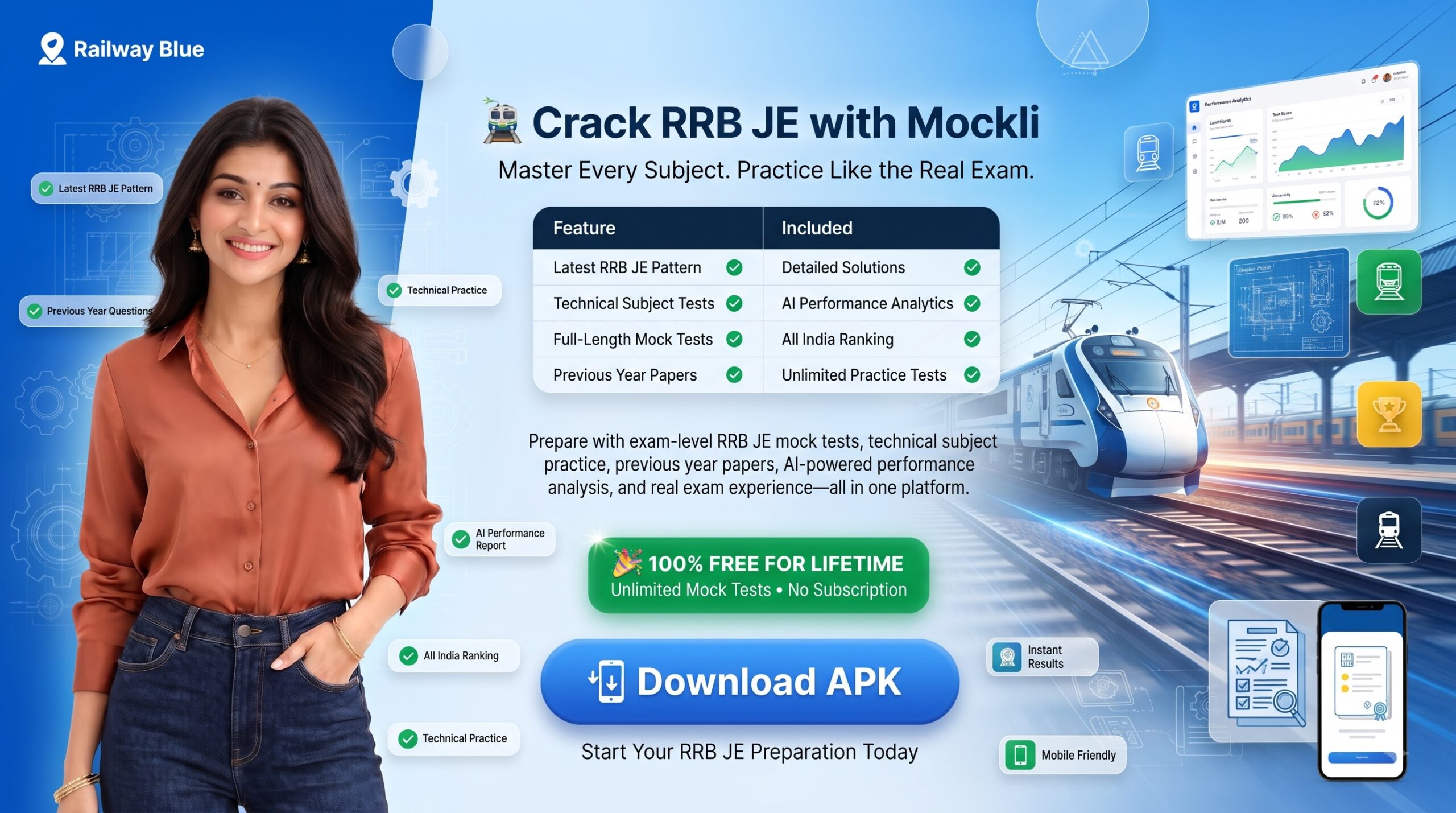
Mockli helps the candidates to prepare better with the help of Free RRB JE Mock Tests, RRB JE Eligibility, RRB JE Previous Year Papers, RRB JE Salary, RRB JE Cut Off, RRB JE Job Profile, RRB JE Medical Standard, topic-wise practice questions, RRB JE Selection Process, and detailed performance analytics. This disciplined style of learning helps convert the theoretical preparation into practical readiness for the examination.
What Is an RRB JE Mock Test?
RRB JE Mock Test is a computer-based simulation test that is very similar to the actual Railway Junior Engineer examination. It is designed in the same way as the prescribed examination pattern, subject distribution, question format, marking scheme, and time duration so that candidates get an environment similar to the real test.
A mock test is different from routine practice exercises as it tests several skills at a time. It tests conceptual understanding, calculation speed, logical reasoning, technical accuracy, and ability to make correct decisions under time pressure. Candidates are also taught to use online navigation tools such as moving between questions, reviewing answers, flagging questions for later review, and tracking time remaining in the exam. Mock tests in official style are specifically designed to help candidates get familiar with the CBT interface and become more ready for the exam.
The more of this environment you are exposed to, the less you doubt and the more confident you become. This means that candidates will be familiar with all sections of the testing process and will not be seeing the computer-based interface for the first time in the real examination.
Why Every RRB JE Aspirant Should Attempt Mock Tests
Many aspirants believe that once they are done with the RRB JE Syllabus, they are automatically prepared for the examination. But competitive exams require a lot more than knowledge of the subject matter. Candidates also have to be able to answer questions efficiently and accurately throughout the paper.
Mock tests help you to build up these examination skills bit by bit. Every exam teaches candidates how to manage their time across different sections, how to spot easier questions, how not to get stuck on harder ones, and how to stay focused under pressure.
Another major benefit is self-assessment. Most times, candidates think they have mastered a topic until a mock test exposes the gaps in their concept or errors in calculation. If we find these weaknesses early, we have time to work on them with focused revision.
Mock tests are also a motivation for disciplined preparation. Candidates who regularly assess their performance become more aware of their progress and can tailor their study plans based on actual results rather than assumptions.
Benefits of Practicing RRB JE Mock Tests
Mock tests are a great way to prepare and not only to check your score. Each practice session builds skills that directly affect how you do on the exam.
Some of the most important benefits are outlined below.
| Benefit | How It Helps |
| Exam Familiarity | Develops confidence with the computer-based examination environment. |
| Time Management | Improves the ability to complete the paper within the prescribed duration. |
| Accuracy Improvement | Reduces careless mistakes through continuous practice. |
| Performance Analysis | Identifies strong and weak subject areas. |
| Revision Support | Highlights topics requiring additional revision. |
| Confidence Building | Reduces examination anxiety through repeated practice. |
Those who take regular mock tests after analyzing their mistakes tend to improve much faster than those who study only theory. Regular CBT-style mock practice also improves your question navigation, speed, and confidence.
Understanding the Real Examination Environment
Mock tests are very helpful as they mimic the actual exam environment. When you sit in front of a computer answering objective questions under strict time limits and making quick decisions, the experience is very similar to the real test.
Many candidates struggle to maintain their focus throughout the entire duration of the exam. Some people waste time on tough questions; some speed through easy questions and make silly mistakes. These habits are slowly corrected with repeated mock test practice.
Candidates also get a feel of the sequence of solving questions. They learn to move on, to return to questions later, and to maintain a steady pace through the paper.
Mock tests are an essential part of successful preparation as practical experience of examination cannot be achieved by just studying from textbooks.
How Mock Tests Improve Time Management
Time management is one of the key skills that are tested in the Railway Junior Engineer examination. As all candidates have the same time for the exam, you should utilize your time wisely to get competitive marks.
A mock test allows candidates to experiment with different examination strategies before the actual exam. Some candidates like to start with Mathematics, and some start with Reasoning or General Science. Again and again, with practice, hopefuls find the best way that matches their strengths.
Candidates are also taught how much time should ideally be given to each section. If a certain subject always seems to take too long, then extra practice can be focused on speeding up that subject.
Over time, repeated exposure to this builds up natural pacing skills that are of great benefit in overall examination performance.
Building Accuracy Through Regular Practice
RRB JE Exam is based on negative marking, so speed is not the only thing that matters for success. Candidates trying to answer quickly but incorrectly could lose valuable marks. Thus, accuracy in construction is as important as improving speed.
Mock tests encourage candidates to think before choosing an answer. Every wrong answer is a chance to discover conceptual errors, math errors, or stupid errors.
Especially useful is review of wrong answers after each test. The candidate should not only know why the right answer is right but why the answer they selected was wrong. The process of reflective learning over time enhances conceptual clarity and decreases repeated errors.
As preparation progresses, candidates will often see more speed and accuracy, which translates into higher overall scores and greater exam confidence.
Identifying Strengths and Weaknesses
Each aspirant has his or her own strengths and weaknesses. There are some candidates who have good knowledge of technical subjects but need to work on General Awareness or Reasoning. Some are good in aptitude sections, but the engineering concepts are difficult.
Mock tests provide objective data on these differences. Candidates get measurable data about how they performed in each subject rather than relying on assumptions.
This allows them to allocate study time more effectively. Strong subjects require regular revision to maintain performance, while weaker areas receive additional attention through targeted practice and conceptual learning.
Mockli’s performance analytics further support this process by helping candidates monitor progress across different subjects and identify improvement trends over time.
Topic-Wise Mock Tests vs Full-Length Mock Tests
Not all mock tests serve the same purpose. Different stages of preparation require different types of assessment, and understanding this distinction helps candidates use mock tests more effectively.
Topic-wise mock tests are particularly useful during the early stages of preparation. After completing an individual chapter, candidates can immediately attempt questions related to that topic. This reinforces learning while identifying conceptual gaps before moving to the next chapter.
As preparation advances, sectional tests become more appropriate because they evaluate broader subject areas under time constraints. Finally, full-length mock tests simulate the complete examination environment by combining all subjects into a single paper.
Following this gradual progression allows candidates to build confidence step by step while continuously improving their examination skills.
When Should You Start Attempting RRB JE Mock Tests?
A question that is frequently asked by aspirants is regarding the appropriate time to begin attempting RRB JE Mock Tests. Many candidates believe they need to cover the entire syllabus before taking their first mock test. This logical approach often inhibits the development of important exam skills such as time management, accuracy, and question selection.
A better approach is to start with RRB JE Syllabus completion gradually, with mock tests. After each chapter is completed, candidates can begin practicing topic-wise tests. This reinforces recent concepts and identifies weak areas before moving on to the next topic.
Sectional mock tests are useful when a few chapters are done as they test a wider area of subjects under time pressure. Full-length mock tests should be introduced once the candidates develop a reasonable understanding of the entire syllabus.
Early mock tests turn preparation into an active learning process and not wait for the final stage to check progress.
Topic-Wise Mock Tests
Topic-wise mock tests are created to test the knowledge of a particular chapter or concept. These are especially useful in the initial stages of preparation as they help the candidate to focus on one subject without the burden of covering the entire syllabus.
For example, candidates can take a topic-based test on Algebra, Coding-Decoding, Structural Analysis, Electrical Machines, or Computer Networks right after studying them. This approach aids in conceptual learning and also reveals any misconceptions before they develop into long-term weaknesses.
One more advantage of practicing according to topics is that the candidates get immediate feedback. If their performance is not up to scratch, then they can revise the relevant chapter immediately rather than finding the problem months later in a full-length examination.
Consistent subject-wise testing builds confidence and strengthens conceptual clarity across every subject covered in the syllabus.
Sectional Mock Tests
After completing a few chapters of similar topics, sectional mock tests are the next level of preparation. These tests mix a number of topics from the same subject and test the ability to solve a wider range of questions in a limited time.
Sectional tests are different from topic-wise tests as candidates have to switch from one concept to another in the same exam. It is closer to the real exam environment and increases the flexibility in solving problems.
Sectional tests help candidates to assess subject-wise preparation. They show whether the conceptual understanding is consistent across a whole subject or particular chapters need more revision.
Candidates should keep on revising the weak topics after every sectional test and gradually increase the level of difficulty in their practice sessions.
Full-Length RRB JE Mock Tests
Full Mock Tests are the Last Step of the RRB JE Preparation for the Examination. These tests are designed as full-fledged mock tests of the Railway Junior Engineer Exam by covering all subjects as per the exam pattern and time limit.
A full-length exam helps candidates to develop examination temperament. They learn how to stay focused during the paper, how to portion their time between sections, and how to move past difficult questions quickly.
Another important advantage is the realistic analysis of the score. It helps candidates to check the overall preparation level instead of checking subjects separately, as every subject is important for the result.
As the exam draws near, conducting mock tests should be a regular feature of the study schedule. However, it is equally important to analyze every test and not just try out multiple papers.
Importance of Mock Test Analysis
Many candidates only pay attention to the scores in mock tests, ignoring the learning opportunities in their mistakes. In fact, going over a practice test can often be more useful for improving than actually taking the test.
After each mock test, candidates should thoroughly analyze each wrong answer. They should look at whether the mistake was because they didn’t understand the concept, made a mistake in their calculations, didn’t check over their work, misread the question,n or ran out of time.
Good questions answered correctly should also be revisited from time to time, because some correct answers may have been due to guesswork rather than conceptual clarity.
Frequent mistakes in a notebook also help in preparation. By reviewing these mistakes periodically, candidates can avoid repeating the same mistakes in future exams.
Continuous analysis ensures that every mock test is a learning experience, not just another practice paper.
Improving Speed Through Mock Tests
Speed develops gradually through repeated exposure to examination conditions. Attempting questions rapidly without proper understanding usually increases mistakes, whereas consistent practice improves both efficiency and confidence over time.
Mock tests help candidates identify where they spend excessive time. Some may require additional practice in Mathematics calculations, while others may lose time solving complex reasoning problems or technical numerical questions.
Once these patterns become clear, candidates can practice those specific question types until they become comfortable solving them more efficiently.
Developing speed should always remain secondary to conceptual clarity. Candidates who first master the concepts generally experience natural improvements in speed as they gain more practice.
Reducing Examination Anxiety
Examination anxiety is common among competitive examination aspirants, especially those appearing for computer-based tests for the first time. Even well-prepared candidates sometimes experience nervousness because they are unfamiliar with the examination environment.
Regular mock tests significantly reduce this anxiety by making the examination format familiar. Candidates become comfortable answering objective questions online, navigating between sections, monitoring the timer, and managing pressure.
As confidence increases, nervousness decreases naturally. By the time of the actual examination, candidates who have attempted numerous mock tests often treat the examination as another familiar practice session rather than an intimidating event.
This psychological advantage can positively influence overall performance.
Developing an Effective Mock Test Strategy
Every candidate eventually develops a personal examination strategy based on repeated mock test experience. Some aspirants prefer solving easy questions first to build confidence, while others begin with their strongest subject to gain momentum early in the examination.
Mock tests provide a safe environment to experiment with these different approaches. Candidates can observe which strategy results in better time management, higher accuracy, and improved overall scores.
Another important aspect is deciding when to skip difficult questions temporarily instead of spending excessive time on them. Through repeated practice, candidates learn to make these decisions quickly and confidently.
The objective is not to imitate another candidate’s strategy but to discover an approach that matches individual strengths and examination habits.
Mock Tests for Technical Subjects
Technical RRB JE Preparation requires more than reading engineering textbooks. Since the second stage of the RRB JE examination focuses heavily on discipline-specific knowledge, candidates should regularly evaluate their understanding through technical mock tests.
These assessments combine conceptual questions with engineering numerical problems, allowing aspirants to apply theoretical knowledge in practical examination scenarios. Technical mock tests also reveal chapters requiring additional revision and highlight concepts that may appear clear during study but become challenging under time pressure.
Candidates should attempt technical mock tests after completing major engineering subjects and continue revisiting weaker chapters until performance becomes consistent.
Mockli offers discipline-specific RRB JE Mock Tests, RRB JE Eligibility, topic-wise technical practice sets, RRB JE Salary, RRB JE Selection Process, RRB JE Job Profile, RRB JE Medical Standard, and sectional assessments that help candidates strengthen their engineering preparation while becoming familiar with the actual examination format.
How Mock Tests Help Complete the RRB JE Syllabus
The most important benefit of taking RRB JE Mock Tests regularly is that they help the candidate to measure how effective his/her RRB JE Syllabus preparation is. Reading books and finishing chapters gives the feeling that preparation is going well. But it is a mock test that can really tell whether or not those concepts can be applied correctly in the available time in the examination.
Each practice test is a practical test of the preparation done till now. The performance in any subject is a good indicator of how well the concepts have been understood and retained. On the other hand, lower scores indicate areas that need more revision or practice.
Mock tests also motivate systematic completion of the syllabus. Knowing that their progress will be evaluated regularly means that candidates are more likely to keep up with their studying, revising, and solving practice questions.
Mock tests should not be considered as a different entity from the preparation but an integral part of the learning process.
Improving Question Selection Skills
In exams, one of the most under-rated skills is knowing which questions to attempt first. In each competitive exam, there will be questions with different levels of difficulty. The candidates who can quickly identify the easier questions are likely to score higher marks.
Mock tests through repeated practice help in developing this ability to make decisions. Many aspirants spend too much time initially on tough questions because they don’t want to leave them unanswered. The more mock tests they attempt, the more they get to know the questions which require long calculations and those which can be solved quickly.
This judgment is very important to develop, because it will greatly improve your overall time management. Candidates learn how to optimise their correct attempts across the entire paper rather than getting bogged down in a few tough questions.
Often, this strategy has more impact on final scores than just knowing more about the subject.
Learning from Every Mock Test
A detailed review session should be conducted after every mock test. Candidates only look at the final score, but the real value of a mock test lies in the understanding of why mistakes were made.
A productive review is going through every wrong answer and figuring out why it was wrong. Some mistakes are due to conceptual misunderstanding, others to calculation errors, failing to revise, or just carelessness. Candidates can learn to correct themselves when they see these patterns.
Candidates should also study guesses of questions answered correctly. Even if you get the right answer without understanding, you should still look at the concept that it relates to.
A record of repeated mistakes helps you not to repeat the same mistakes in the upcoming mock tests. With time, this cycle of continuous improvement leads to greater conceptual understanding and more confidence in examinations.
Tracking Performance Over Time
Preparation is significantly more effective when candidates track their progress regularly rather than using assumptions. Mock tests provide quantifiable data that allows aspirants to measure improvement objectively.
Candidates should consider trends within individual subjects, not just overall scores. A positive step forward for you could be a slow rise in Mathematics accuracy, progress in the technical sections, or a faster pace in solving Reasoning questions.
Tracking the progress over a few weeks also helps you spot topics that have levelled off and topics that need extra attention. It allows candidates to distribute their study time more efficiently, rather than revising each subject equally.
Mockli’s detailed performance analytics ease this process with organized subject-wise accuracy, question-wise analysis, time utilization, and overall progress.
Balancing Accuracy and Speed
The Railway Junior Engineer exam rewards candidates who are fast and accurate. Concentrating on the quick solving of questions could result in more careless mistakes, and concentrating on accuracy could result in fewer questions attempted.
Mock tests help the candidates to gradually attain the right balance. In the very beginning of the RRB JE Preparation, aspirants should focus on conceptual clarity and correct problem solving. Once confidence is enhanced, they can start working on completing the paper in shorter durations.
With experience, speed will automatically come as candidates get familiar with question patterns, formulas, reasoning, and engineering concepts. This slow improvement is much more sustainable than trying shortcuts without understanding the concepts under your belt.
Regular practice and mock tests to keep accuracy high and gradually improve speed are one of the main aims.
Using Mock Tests for Revision Planning
Revision is far more effective when it is based on actual performance rather than assumptions. Mock tests tell you the chapters that you have to give your immediate attention and the subjects that you have already mastered.
Candidates should consider each mock test as a revision guide. First review the topics in which mistakes are repeated. Then give more practice questions to ensure that they understand. Students who are consistently performing well need to revise periodically to maintain their confidence.
This targeted approach towards revision saves a lot of time as the candidates work on their actual weaknesses rather than trying to revise all the chapters equally. The more you prepare, the smarter and more efficient the revision becomes.
Mock tests thus become not merely assessment tools but also useful revision planners.
Common Mistakes While Taking RRB JE Mock Tests
Mock tests are very useful, but sometimes candidates spoil their effectiveness by adopting wrong practices. Knowing these errors will enable you to make the most of each practice session.
One of the common mistakes is that they take mock tests without examination discipline. “You keep pausing the timer, looking up books, discussing answers, and then you’re not even being realistic about scores while taking the test.
Another mistake is that you take several mock tests without analyzing the previous performance. More is not always better. After every test, careful analysis is important to find out conceptual weaknesses and avoid repeating errors.
Early mock tests with low scores also demotivate some candidates. It is important to remember that mock tests are learning tools, not final evaluations. Bad performance only points out the places where we need to practice more.
Lastly, time management is something many hopefuls miss in their practice. Treating every mock test like a real examination helps in developing habits which are of immense value on the day of the actual examination.
Integrating RRB JE Mock Test with Daily Preparation
The mock tests are meant to supplement the daily study and not to replace it. Candidates should continue to learn new concepts and periodically evaluate their progress via structured assessments.
A practical way to prepare would be studying new chapters during the week, revising the topics already covered, and taking a mock test after covering a good part of the syllabus. Then you can spend the next day reviewing mistakes and making the weaker concepts stronger.
This cycle of learning, practicing, analyzing, and revising keeps you improving all the time during the period of RRB JE Preparation. Candidates are still getting to grips with the syllabus but steadily honing examination skills.
Aspirants can include these mock tests in their daily routine. This gradually transforms theoretical knowledge into practical performance on the examination.
Building Examination Confidence Through Practice
You don’t get confidence by reading books. It is developed through repeated success in answering questions under test conditions. The more mock tests you give, the less uncertainty there is and the more you get used to the format of the examination.
Candidates who regularly take mock tests are usually more composed in the actual examination as they have faced similar situations many times during their preparation. They know how to manage time, answerquestions andd keep concentration throughout the paper.
This confidence also improves decision-making. Experienced candidates are not in a panic when faced with unfamiliar questions but keep calm, think logically and go ahead with the examination in an orderly manner.
Mockli’s Free RRB JE Mock Tests along with topic-wise practice, RRB JE Eligibility, RRB JE Salary, RRB JE Selection Process, RRB JE Cut Off, RRB JE Job Profile, RRB JE Medical Standard, sectional assessments and previous year papers give aspirants the practical experience to build this level of examination confidence before facing the actual Railway Junior Engineer examination.
Best Mock Test Strategy Before the Examination
The significance of RRB JE Mock Testsincreasingting with the examination approaches. In the last phase of preparation, candidates should reduce time on studying new topics and spend more time on revision. They should take full-length mock tests and analyse their performance.
Instead of doing a lot of mock tests without review, aspirants should focus on quality practice. Review all tests taken for conceptual errors, time management errors, and common errors. You keep doing new papers without reflection, and it is so much better to work on these weak points before you go for the next mock test.
Candidates should also try a mock test in a simulated manner of the examination. Build confidence and discipline by studying in a quiet environment, sticking to the time limit, avoiding distractions and treating the mock test as the real exam.
“It’s been consistency over intensity the last few weeks. Candidates who revise, take mock tests and get proper rest will be able to appear for the examination with a relaxed and confident mindset.
How to Analyze an RRB JE Mock Test
“Attempting a mock test is just half of the preparation. The real improvement comes when candidates review their performance once they have completed the paper. A systematic analysis will focus on some important areas:
| Area of Analysis | Purpose |
| Correct Answers | Identify concepts that are well understood. |
| Incorrect Answers | Understand conceptual mistakes and revise weak topics. |
| Unattempted Questions | Determine whether they were skipped because of lack of knowledge or poor time management. |
| Time Spent Per Section | Evaluate whether sufficient time was allocated to each subject. |
| Accuracy Percentage | Measure the balance between speed and correctness. |
Candidates should write these observations after each mock test. And you can prepare more and more efficiently; patterns repeat over time.
Combining Mock Tests with Previous Year Papers
Mock tests and previous year papers are inseparable and should be used simultaneously during the preparation. Mock tests help you to improve your time management skills and to simulate the examination environment. The past year papers will give you an idea about the level and style of questions asked in the Railway Junior Engineer examination.
Candidates should study regularly to improve their conceptual knowledge and then solve previous year papers to understand the trend of questions, and then evaluate themselves through mock tests.
The combination builds conceptual understanding and exam skills. The papers of previous years give an idea of the important topics, and the mock tests test how well the candidates can apply these concepts in exam conditions.
Combining these two resources offers a well-rounded method of RRB JE Preparation that promotes ongoing improvement.
Why Online Mock Tests Are Better for CBT Preparation
Since the RRB JE exam is conducted as a Computer-Based Test (CBT), preparation in a similar online environment is an added advantage. If candidates only practice with printed question papers, they will not be fully prepared for the digital interface they will be presented with in the actual examination.
Online mock tests familiarize candidates with screen-based navigation, question review options, timer management, answer selection, and the overall flow of the computer-based examination. These practical experiences reduce hesitation on the examination day and allow candidates to focus entirely on solving questions.
Another advantage of online platforms is instant performance analysis. Candidates receive immediate feedback regarding their scores, accuracy, time management, and subject-wise performance, allowing them to modify their preparation strategy accordingly.
Mockli offers online RRB JE Mock Tests that closely replicate the actual examination environment, helping aspirants become comfortable with the CBT format before the examination. A strategy that supports continuous improvement.
Why Mockli Is the Right Platform for RRB JE Mock Tests
Preparing for the Railway Junior Engineer examination requires more than simply practicing random questions. Candidates need structured assessments that closely follow the syllabus and exam pattern while providing meaningful feedback after every test.
Mockli has been designed with these objectives in mind. The platform supports aspirants through every stage of preparation by offering carefully prepared mock tests, detailed explanations, topic-wise practice, and comprehensive performance analysis.
Candidates preparing through Mockli can access:
- Free RRB JE Mock Tests
- Full-Length Mock Tests
- Topic-wise Practice Tests
- Sectional Mock Tests
- RRB JE Previous Year Papers
- Detailed Performance Analytics
- Subject-wise Progress Tracking
- Current Affairs Practice
- Engineering Practice Questions
- Revision Support
These resources help candidates build conceptual understanding while simultaneously improving examination skills through continuous practice.
Related Resources to Strengthen Your Preparation
Mock tests become even more effective when they are combined with other important preparation resources. Candidates should develop a complete understanding of every stage of the recruitment process rather than practice papers alone.
Along with regular mock test practice, aspirants should also study:
- RRB JE Syllabus to understand the complete subject coverage.
- RRB JE Exam Pattern to become familiar with the structure of the examination.
- RRB JE Eligibility to understand qualification requirements.
- RRB JE Salary to learn about career benefits.
- RRB JE Preparation for effective study strategies.
- RRB JE Previous Year Papers to understand question trends.
- RRB JE Selection Process to know every stage of recruitment.
- RRB JE Cut Off to understand the level of competition.
- RRB JE Medical Standard to learn about fitness requirements.
- RRB JE Job Profile to understand the responsibilities of a Junior Engineer.
Study of these interrelated topics develops a comprehensive preparation framework and contributes to the candidates’ increased confidence in the examination.
Frequently Asked Questions (FAQs)
1. Why are RRB JE Mock Tests important?
RRB JE Mock Tests are developed to give a feel of the real examination environment and also to enhance time management, speed, accuracy, and confidence. They also identify weak areas that need to be improved. Regular Mock Tests are the bridge between theoretical preparation and practical exam performance and are a must in any preparation strategy.
2. When should I start taking RRB JE Mock Tests?
Candidates should start taking the topic-wise mock tests as soon as they finish individual chapters. Once major portions of a subject have been covered, sectional mock tests can be taken. Once a considerable part of the syllabus has been completed, full-length mock tests should be attempted. Starting early means you are always improving through the preparation.
3. How often should I attempt full-length mock tests?
The frequency depends on the stage of preparation. In the first stage, after completing important portions of the syllabus, candidates can attempt them occasionally. As the exam nears, full-length mock tests should be a regular feature of the study plan, followed by proper analysis of performance and targeted revision.
4. Should I analyze every mock test?
Yes, analysis is one of the most important parts of mock test preparation. Candidates should review the wrong answers to understand conceptual mistakes and time management problems and revise the weak topics before appearing for the next mock test. Incrementally improve your knowledge and test strategy as you analyze.
5. Are online mock tests better than printed practice papers?
Yes. As the Railway Junior Engineer examination is also a computer-based test, online mock tests give a more real examination experience. Candidates also get accustomed to digital navigation, time management, and solving questions on the screen with instant performance analysis.
6. Can mock tests replace studying the syllabus?
Nope. The purpose of mock tests is to supplement the syllabus-based preparation and not to replace it. Candidates should also be able to apply their knowledge well under exam conditions. The best way to do this is to take mock tests after building up conceptual understanding through systematic study.
7. How do mock tests improve accuracy?
Mock tests help the candidates to identify careless mistakes, conceptual misunderstandings, and calculation errors, thereby improving accuracy. Through practice and analysis, repeated mistakes are reduced gradually, and confidence in choosing correct answers in the exam is built up.
8. Should I solve previous year papers along with mock tests?
Yup. Mock tests and previous year papers serve different but complementary purposes. Previous papers will give an idea about the question pattern and important topics, whereas mock tests will provide an actual examination environment and will help in improving examination skills like time management, accuracy, etc.
9. What should I do if my mock test scores are low?
Poor preparation scores that are poor should be learning experiences, not failures. Candidates should go through their mistakes thoroughly, revise the weaker topics, practice more questions, and keep on taking mock tests on a regular basis. Getting high marks early in your preparation is far less important than improving consistently over time.
10. How can Mockli help me with RRB JE Mock Tests?
Mockli provides Free RRB JE Mock Tests, full-length examinations, topic-wise practice tests, sectional assessments, RRB JE Selection Process, RRB JE Cut Off, previous year papers, RRB JE Eligibility, detailed explanations, RRB JE Job Profile, RRB JE Medical Standard, and advanced performance analytics. These resources help candidates strengthen concepts, improve examination skills, monitor progress, and prepare systematically according to the Railway Junior Engineer examination pattern.
Unlock Your RRB JE Success With Mockli
A well-planned RRB JE Mock Test strategy is one of the most effective ways to transform preparation into examination success. While studying the syllabus builds knowledge, mock tests teach candidates how to apply that knowledge efficiently under real examination conditions. They improve speed, accuracy, time management, decision-making, and confidence while helping aspirants identify and correct their weaknesses through continuous practice.
The most successful candidates treat mock tests as learning tools rather than scorecards. Every test provides valuable insights into conceptual understanding, examination temperament, and subject-wise performance. Combined with regular revision and previous year paper practice, mock tests become an indispensable part of a structured preparation strategy.
Mockli supports aspirants throughout this journey by offering Free RRB JE Mock Tests, RRB JE Previous Year Papers, Topic-wise Practice Questions, RRB JE Salary, RRB JE Selection Process, Sectional Tests, RRB JE Eligibility, RRB JE Cut Off, RRB JE Job Profile, RRB JE Medical Standard, Study Material, Current Affairs, and Performance Analytics. These resources are designed to help candidates strengthen every aspect of their preparation while becoming fully familiar with the computer-based examination format.
With consistent practice, detailed analysis, and disciplined preparation, RRB JE Mock Tests can significantly improve examination readiness and bring aspirants one step closer to achieving their goal of becoming a Railway Junior Engineer.