

The RRB JE Cut Off is a very important aspect of the Railway Junior Engineer recruitment process as it gives the candidates an idea of the competition level and the performance usually needed to clear different selection stages. Most of the aspirants, while preparing for the examination, concentrate on covering the RRB JE Syllabus and solving the questions. Moreover, knowing the cut-off determination also helps the candidates in setting realistic preparation goals and evaluating their readiness for the examination.
A cutoff is not just a static score that remains constant for every recruitment cycle. Instead, it is the minimum qualifying or selection benchmark arrived at by considering various factors such as the difficulty of the examination, number of candidates appearing, available vacancies, normalization across multiple shifts, and overall candidate performance. The cut-off also varies accordingly as these factors vary from one recruitment cycle to another. RRB also specifies minimum qualifying marks for each category, and final shortlisting is done based on merit after normalization and other recruitment factors.
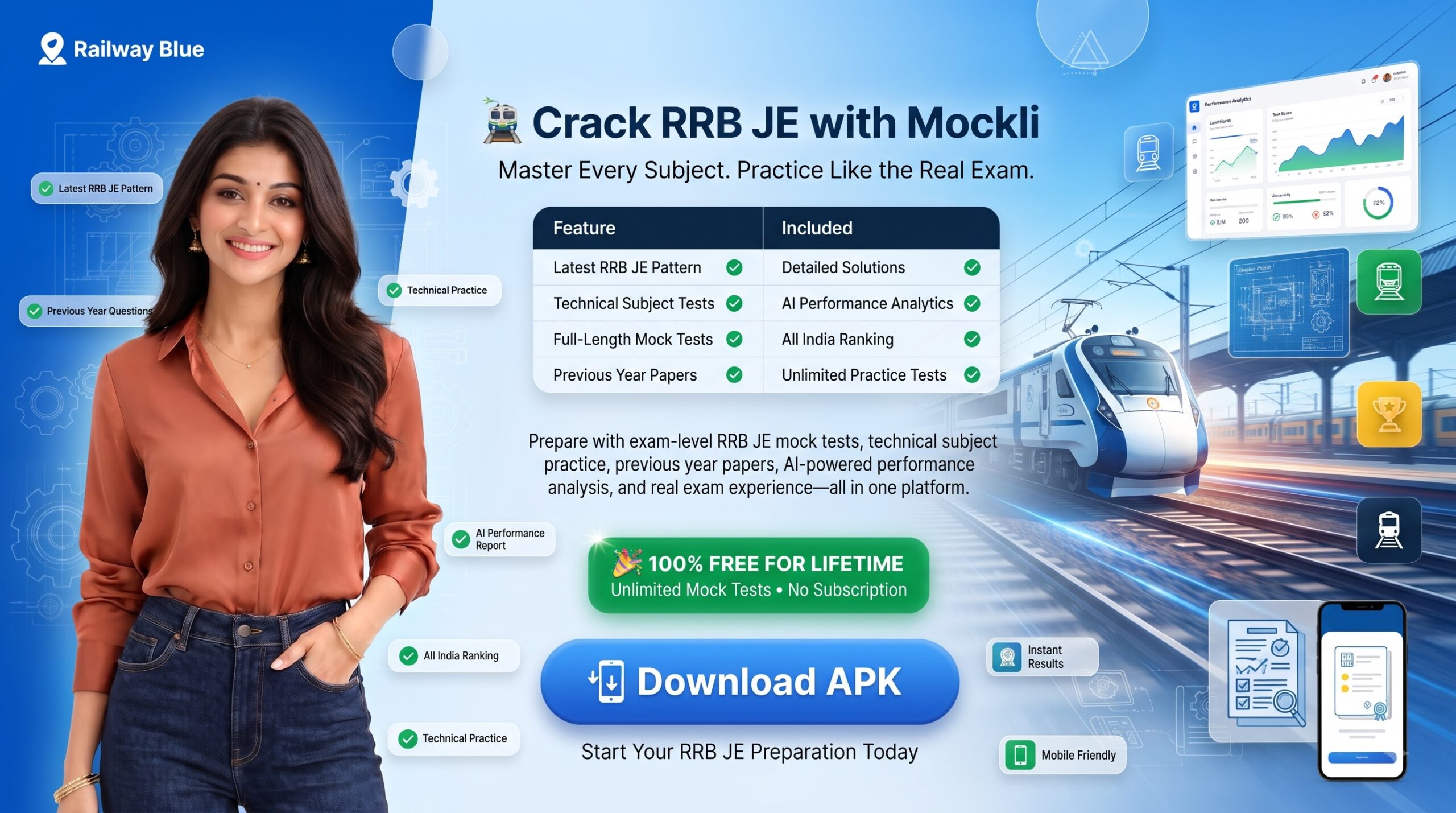
Candidates preparing through Mockli can check the RRB JE Cut Off to check their performance while attempting RRB JE Mock Tests, RRB JE Eligibility, RRB JE Previous Year Papers, RRB JE Salary, RRB JE Selection Process, RRB JE Job Profile, RRB JE Medical Standard, and topic-wise practice questions. Candidates should not just target qualifying but should target easily exceeding the expected competition level.
What Is the RRB JE Cut Off?
RRB JE Cut Off is the minimum marks a candidate must score to qualify for the next round of recruitment or to be considered for the final selection (depending upon the stage of the examination).
There is a difference between the actual cut off and minimum qualifying marks. Minimum qualifying marks are the minimum eligibility score prescribed for the examination, and cut off is the score of the last shortlisted candidate, considering the factors of merit, vacancies, normalization, and reservation policies. This means that the final cut off is usually higher than the minimum qualifying requirement. The official RRB FAQs state that minimum qualifying marks are category-wise, but actual selection is on merit and available vacancies.
A clear understanding of this difference will help candidates not to fall prey to the misconception that scoring the minimum qualifying marks will automatically lead to the next stage.
Why Understanding the Cut Off Is Important
Knowing the cut off will have a few practical benefits during your preparation. First, it allows candidates to determine if their current performance is high enough to get through the recruitment process.
Secondly, it enables aspirants to set measurable goals for their preparation. Instead of preparing without any benchmark, candidates can use previous cut-off trends to get an idea of the level of performance generally expected for selection.
It also helps you to analyze your mock tests better. After each mock test, candidates can compare their scores with historical cut off trends and check if they need to revise more or improve in a particular subject.
Finally, knowing the cut off makes candidates aim beyond the qualifying cut off. As the competition is different from one recruitment cycle to another, a good score margin improves the chances of success.
Difference Between Minimum Qualifying Marks and Cut Off
These two terms are used interchangeably by a lot of candidates, but they mean different things in the recruitment process.
| Term | Meaning |
| Minimum Qualifying Marks | The minimum percentage or score prescribed to remain eligible in the examination. |
| Cut Off | The actual score of the last shortlisted candidate after considering merit, vacancies, normalization, reservation, and competition. |
For example, a candidate may secure the prescribed qualifying marks but may not be able to go forward if the overall competition results in a significantly higher cut off.
This difference in knowledge motivates candidates to study more than the minimum eligibility level and not just be qualified.
Types of RRB JE Cut Off
The Railway Junior Engineer recruitment process is multi-tiered, and different cut-offs may be applicable at different stages in the selection process. Typically, candidates face:
| Cut Off Type | Purpose |
| CBT 1 Cut Off | Determines shortlisting for CBT 2. |
| CBT 2 Cut Off | Determines shortlisting for Document Verification. |
| Final Merit Cut Off | Represents the score required for final selection after completing all prescribed stages. |
Each stage is for a different purpose in the recruitment process, and cut-off is prepared separately as per the applicable recruitment rules and merit requirements. RRBs publish stage-wise results and cut-offs after evaluation and normalization wherever applicable.
CBT 1 Cut Off
CBT 1 Cut Off is used to shortlist the candidates for the second round of the Railway Junior Engineer recruitment process. CBT 1 is the screening examination, and the cut-off decides the candidates who are eligible to appear for CBT 2.
CBT 1 is mainly based on Mathematics, General Intelligence and Reasoning, General Science, and General Awareness. The competition is intense due to the large number of engineering graduates and diploma holders appearing in the examination.
Candidates should therefore prepare well for aptitude subjects and not think that technical knowledge alone will lead to progression to the next stage.
Regular practice of the RRB JE Mock Tests and Previous Year Papers is very helpful in clearing the CBT 1 cut off.
CBT 2 Cut Off
The significance of the CBT 2 Cut Off is generally higher as it determines which candidates will proceed to document verification and final selection.
Unlike CBT 1, CBT 2 focuses more on technical engineering knowledge as well as selected general subjects. The competition here is tougher as the contenders coming for CBT 2 have already passed the first screening stage.
To do well in this examination, good concept clarity, revision, and engineering practice for respective disciplines become imperative. Candidates who score consistently good marks in the technical mock tests usually gain more confidence before attempting CBT 2. Final Merit Cut Off
Final Merit Cut Off
Final Merit Cut Off is the score level till which the last candidate is selected as per the concerned recruitment rules after completion of the prescribed selection stages.
This cut off is subject to written examination performance, normalization wherever applicable, reservation policy, availability of vacancies, and successful completion of document verification and RRB JE Medical Standard examination.
Candidates should be aware that there is a final selection on merit and not just passing individual stages. So, RRB JE Preparation should always try to maximize the overall performance and not just try to get the expected cut-off.
In highly competitive recruitment cycles, aiming significantly above past trends usually provides a safer cushion.
Factors That Affect the RRB JE Cut Off
Many important factors are involved in determining the RRB JE cut off. Instead of being constant, the cut off also varies, as these variables change with every recruitment process. Some of the major factors that affect the cut off are:
| Factor | Influence on Cut Off |
| Number of Vacancies | Fewer vacancies generally increase competition and may raise the cut off. |
| Number of Candidates Appearing | Higher participation often leads to stronger competition. |
| Difficulty Level of the Examination | Easier papers may result in higher cut offs, while difficult papers may reduce them. |
| Candidate Performance | Better overall performance generally increases the cut off. |
| Normalization Across Multiple Shifts | Adjusts scores fairly when examinations are conducted in different shifts. |
| Reservation and Category-wise Merit | Separate category-wise merit lists influence the final cut off. |
These factors help the candidates understand why the cut off varies every recruitment cycle and why it is not practical and reliable to predict an exact score beforehand.
How the RRB JE Cut Off Is Determined
It is a common notion among many candidates that the RRB JE Cut Off is decided before the exam is conducted. In fact, the cut off is decided only after the completion of the examination process and checking of answer sheets. The Railway Recruitment Boards take into account several important factors while preparing the final merit list for each stage of recruitment.
The first thing to look at is the performance of the candidates. However, if the number of good candidates is large, the cut-off can go up as the competition gets tougher. However, if the exam is relatively hard and the overall scores are lower, then the cut off may also be lower.
Another important parameter is the number of available vacancies in a particular recruitment cycle. The ratio of vacancies and qualified candidates is a major factor that decides the final cut off, as the candidates are selected based on merit.
Normalization is also done wherever applicable in cases where examinations are held in multiple shifts so as to ensure fairness across different sessions. All these factors are considered, and category-wise and stage-wise cut-offs are prepared as per the recruitment rules. RRB conducts multi-shift CBTs with score normalization and prepares merit lists based on normalized marks and applicable recruitment rules.
Category-Wise Cut Off
The recruitment to the Railway Junior Engineer will be done as per the reservation policies prescribed for recruitment to the Central Government. Hence, separate cut-offs are generally prepared for different reservation categories as per applicable rules.
The category-wise cut-offs are designed to ensure that the recruitment is done fairly as per the reservation structure given by the Government of India. Thus, candidates mainly compete within their own categories, subject to applicable merit criteria.
The cut-offs may vary category-wise, but all the candidates are advised to try to improve their performance in the exam as much as possible and not try to guess a particular cut-off score. The higher the score, the higher the chance of moving on to the next stage of the recruitment process.
Therefore, candidates should prepare as per the complete RRB JE Syllabus and not just an estimated cut off.
Zone-Wise Variation in Cut Off
Another important aspect of the RRB JE recruitment process is that the cut-offs may differ from one Railway Recruitment Board or zone to another.
There are a number of practical reasons why this can vary. The number of vacancies, the number of applicants, the level of regional competition, and the performance of candidates can vary from one recruitment board to another. Thus, the same marks can lead to different outcomes depending on the recruitment board the candidate applied under.
Such variation is a normal phenomenon in large-scale recruitment across several regions. Candidates should therefore not compare cutoffs across different recruitment boards without understanding the factors behind those differences.
The aspirants should focus on scoring maximum marks through consistent preparation and not on regional differences.
Effect of Examination Difficulty on Cut Off
The RRB JE cut off is determined by the difficulty level of the examination. Competitive examinations are well designed in a manner that the level of questions may differ slightly in different recruitment cycles, still testing the prescribed RRB JE Syllabus.
If the overall examination is relatively easy, a greater number of candidates tend to score higher. Therefore,e the cut-off may also grow as competition becomes fiercer.
However, if the exam has tough conceptual/technical questions, the overall performance of the candidates might come down, and the cut-offs might be lower in comparison.
Thus, candidates should not try to guess the cut off only based on the previous recruitment trends. The best strategy is to still study well so that you can get the best possible score, no matter how difficult the exam is.
Role of Normalization in RRB JE Cut Off
The Railway Junior Engineer exam is typically conducted in several shifts because a large number of candidates appear for it. Where appropriate, a normalization process is applied to ensure fairness, as slight variations in question difficulty may naturally occur across different sessions.
Normalization is a statistical adjustment of the scores to ensure that the candidates appearing in different shifts are assessed fairly. It is not about adding or subtracting marks arbitrarily but to ensure that no candidate is unfairly advantaged or disadvantaged on account of the relative difficulty of a particular examination shift.
Understanding of normalization helps the candidates to understand why the raw and normalized scores might be different in a multi-shift examination. It also justifies why the final cut-off is decided only after the whole evaluation process is over.
Candidates should therefore concentrate on giving their best in the examination and not worry about possible normalization adjustments.
Previous Year Cut Off Trends
Candidates can get an idea of the level of competition for the Railway Junior Engineer exam by analyzing previous cut off trends. Although past cut offs are not exact predictions for future recruitment, they do give useful reference points while preparing.
Historical trends provide aspirants with an idea of what kind of performance is generally required to remain competitive. They also suggest that candidates should aim to score well above the minimum score, rather than aiming for the minimum score.
However, the candidates should note that the cut-offs change due to changes in vacancies, participation of candidates, difficulty level of examination, normalization, and overall merit. Hence, historical trends should be used as a guide for preparation, not as a guarantee of future outcomes.
Mockli recommends the use of the prior cut-off information mainly for self-assessment, but a consistent focus on conceptual learning and examination performance is suggested.
How to Use Cut Off Trends During Preparation
Information cut off is most useful when incorporated into a systematic preparation strategy rather than being used as a prediction tool.
Candidates can use the previous trends of cut off to analyze their mock test scores and thus can analyze their RRB JE Preparation objectively. If mock scores are not consistently competitive, then more revision and practice are required. On the other hand, candidates who consistently score well above previous trends can improve their performance with regular practice.
Another good way is to keep track of the subject-wise scores. The aspirants should not focus on the overall score but try to find the weaker sections and work on them gradually. This balance often leads to better overall performance than simply focusing on the subjects that you are already good at.
The goal should always be ongoing improvement rather than just hitting an estimated cut off.
Common Misconceptions About the RRB JE Cut Off
There are many misconceptions about the cut off, and knowing them will help the candidates to gain more confidence in their preparation.
There is a common misconception that clearing the minimum qualifying marks means selection. In fact, the final shortlisting is based on merit, vacancies, normalization, and competition category-wise and not only on the qualifying score.
Another misconception is that the previous year cut-offs are a good indicator of future recruitment. Each recruitment cycle is different in terms of the level of competition and exam conditions, so it is not possible to make precise predictions.
Some candidates also think that the cut-offs are the same for all Railway Recruitment Boards. As stated above, there are different cut-offs for different recruitment boards. This is often due to regional factors.
Finally, a lot of aspirants get demotivated after hearing unofficial cut off estimates just after the exam. Estimates like these are speculative and should not affect preparation or confidence. Candidates are advised to keep checking the officially declared results and keep preparing positively until the recruitment process is over.
How Mock Tests Help You Stay Above the Expected Cut Off
Regular mock test practice is one of the best ways to prepare above the expected cut off. Mock tests give an objective assessment of one’s current level of preparation and help candidates improve their speed, accuracy, and exam strategy.
Candidates must regularly analyze the mock test scores with past competitive marks. It should be noted that the aim is to constantly improve rather than to hit a certain number.
Performance analysis after each mock test is equally important. The process of identifying weak topics, revising them systematically, and monitoring progress over time gradually increases examination readiness.
Free RRB JE Mock Tests, Previous Year Papers, Topic-wise Practice Questions, and Detailed Performance Analysis help aspirants assess their preparation level as per the competition and improve their performance continuously.
Setting a Safe Target Score Instead of Chasing the Cut Off
The most effective preparation strategy for the Railway Junior Engineer examination is to aim for a safe target score rather than focusing on the RRB JE Cut Off. Preparing for a fixed score can be risky as the cut-off keeps changing in every recruitment cycle based on various factors.
If you’re always striving for the highest possible score, you’ll be better off no matter what the difficulty of the exams or the competition. A higher score also provides a comfortable buffer if the cut-off rises due to better performance of the overall candidate pool.
Candidates must ask, “How can I maximize my score?” not, “What will be the cut off?” This shift in thinking encourages continuous learning, thorough revision, and improved exam results.
Preparing beyond the expected level of competition also boosts confidence, as the candidates are not relying on uncertain cut-off predictions.
How Mock Test Scores Can Be Compared with Cut Off Trends
Candidates benefit more from mock tests if they compare their performance with previous competitive benchmarks. Mock test scores can’t predict the official cut off, but they give an insight into the examination readiness.
Candidates are advised to keep checking their progress and scores throughout the period. If the performance is consistently below the level of the competition in the past, then more attention should be given to weaker subjects. As you get better with your scores, you can slowly start to work on improving speed, accuracy, and exam strategy.
Instead of getting discouraged by some low scores, aspirants should look at each mock test as an opportunity to strengthen their preparation.
The goal is to keep getting better rather than to become perfect on each practice test.
Improving Your Score Above the Expected Cut Off
It is not just about completing the RRB JE Syllabus to get a competitive score. Systematic preparation: The candidates should keep on working on their overall examination performance on a continuous basis.
RRB JE Preparation still has to be based on conceptual understanding. Practice regularly, and as concepts become clear, speed and confidence will improve. Previous year papers give candidates an idea of the actual examination questions, while mock tests help develop practical examination skills.
Revision matters, too. Students who revise regularly tend to retain things better and make fewer mistakes in the exam.
The analysis of performance after each practice session also helps in improving the score by identifying weak areas that need more attention.
Combined, these strategies enable candidates to slowly pull well ahead of expected competition levels.
Importance of Accuracy in Achieving a Higher Score
Many candidates just focus on trying to answer as many questions as possible. You can earn more points by attempting more questions. But you can also get penalized for wrong answers (depending on the marking scheme). So you also want to be correct.
Accuracy is developed through conceptual clarity and not through rote memorization. Before candidates attempt to increase their speed, they should have a good understanding of engineering principles, mathematical methods, reasoning techniques, and scientific concepts.
Higher accuracy is also achieved by careful review of mistakes made in mock tests and previous year papers. Knowing why an answer was wrong is helpful to avoid making similar mistakes on tests in the future.
With regular practice over a period of time, candidates can improve their speed and accuracy, and this will lead to a better overall score.
Subject-Wise Improvement Strategy
Every candidate performs differently in each subject. Some aspirants may perform well in the technical engineering topics but need to work on Mathematics or General Awareness. Others may show strong aptitude skills but need more revision in technical subjects.
It’s not a question of giving equal time to each subject. Candidates should constantly assess their performance and find out which subjects they are weak in. Additional practice should be directed towards those subjects until balanced performance is achieved.
Strong subjects should continue to be reviewed periodically so that performance is consistent throughout preparation.
This strategy of improving by subject results in a more efficient preparation process than studying all the subjects without taking into account the actual performance.
Time Management and the Cut Off
Good time management is directly related to the ability to achieve a competitive score. A candidate with a good knowledge of the subject may not do well if he cannot complete the paper within the time allotted.
Regular practice tests help the candidate to figure out the ideal time that should be spent on each section. Constant practice enables the aspirants to spot the easier questions at a glance, not to waste much time on the difficult problems, and to keep a steady speed throughout the examination.
Good time management will also reduce examination stress as candidates will know how they are progressing through the paper and will not feel the pressure as the examination draws to a close.
Gradually building this skill will increase the chances of getting scores comfortably above the expected cut off.
Avoiding Common Mistakes While Targeting the Cut Off
Candidates sometimes reduce their chances of success by adopting ineffective preparation methods while trying to achieve the expected cut off.
One of the most common mistakes is not practicing beyond the estimated qualifying scores in the mock tests. The risk of limiting your preparation in this way is that real competition varies from one recruitment cycle to another.
Another mistake is to focus on the stronger subjects and leave the weaker ones. Better overall results will generally be achieved by even preparation in all subjects.
Some candidates also get diverted by unofficial cut-off discussions right after the examination. Candidates should focus on improving their preparation until the recruitment process ends instead of thinking about any speculation.
One of the most common reasons for poor examination performance despite completing the RRB JE Syllabus is the neglect of revision.
Maintaining Confidence Regardless of the Expected Cut Off
Competitive examinations are by their nature uncertain because candidates cannot have access to the official cut off before the announcement of results by the recruitment authority. This uncertainty, if allowed to influence your preparation, often unnecessarily erodes confidence.
The most productive approach is to focus entirely on what you can control. Candidates can enhance their conceptual understanding, reinforce their technical knowledge, revise regularly, practice mock tests, and analyze their mistakes. The prediction of the cut-off does not directly influence the performance of the examination, but the prediction of these actions does.
A positive and disciplined mindset throughout the preparation is what helps the candidates to perform better in the actual examination.
Confidence from steady preparation is much more dependable than confidence based on unofficial predictions of your score.
Role of Performance Analytics in Score Improvement
Modern preparation platforms offer a detailed performance analysis that is much more than just a total score. These analytics help candidates know where exactly improvement is needed.
Usually, performance reports include subject-wise accuracy, question-wise analysis, time utilization, strengths, weaknesses, and comparison with previous attempts. Such information allows candidates to make informed decisions on future study plans.
With Mockli’s Performance Analytics, aspirants can track their progress in a systematic manner and figure out the areas that need further revision. These insights, along with RRB JE Mock Tests, RRB JE Eligibility, Previous Year Papers, RRB JE Salary, RRB JE Selection Process, RRB JE Job Profile RRB JE Medical Standard, and topic-wise practice questions, help candidates constantly improve their preparation and get closer to achieving scores well above the expected competition level.
Final Strategy to Stay Above the RRB JE Cut Off
RRB JE Cut Off RRB JE Preparation should not be based on guessing expected scores or comparing unofficial predictions. The safest approach is to study in such a way that you consistently score well above the likely level of competition. Candidates who focus on optimizing their own performance are usually better prepared for changes in the difficulty of the examination, normalization, or the general level of competition.
The final stage of preparation should be revision, full-length mock tests, previous year papers, and regular performance analysis. Candidates need to practice on a regular basis to strengthen the concepts already learnt and improve their examination strategy rather than learn new topics.
Consistency is important too. A proper revision plan with regular practice of mock tests helps the candidates to remember important concepts and also minimizes the chances of avoidable mistakes in the examination.
Rather than getting caught up in things that you cannot control, aspiring candidates should focus on improving their own preparation, day by day.
How Mockli Helps You Prepare Beyond the Cut Off
To score well on the test, you need to prepare in a structured manner and have reliable learning resources. Mockli is designed to help Railway Junior Engineer aspirants improve all aspects of their exam preparation, rather than just score predictions.
Candidates can improve their conceptual understanding, monitor their progress, and keep improving their preparation strategy every time through several learning resources on a single platform with Mockli.
Some of the main resources for preparation are:
- Free RRB JE Mock Tests
- Full-Length CBT Practice Tests
- Topic-wise Practice Questions
- Sectional Mock Tests
- RRB JE Previous Year Papers
- Detailed Performance Analytics
- Subject-wise Progress Reports
- Current Affairs Practice
- Engineering Practice Questions
- Comprehensive Study Material
These resources help candidates to improve their accuracy, speed, and confidence while preparing as per the Railway Junior Engineer examination pattern.
Related Resources for Complete RRB JE Preparation
Candidates also need to develop a complete understanding of the recruitment process, and then the understanding of the cut-off becomes more meaningful. Along with the cut off, candidates should also check other important topics of preparation. Some useful resources are:
- RRB JE Syllabus
- RRB JE Exam Pattern
- RRB JE Eligibility
- RRB JE Preparation
- RRB JE Mock Tests
- RRB JE Previous Year Papers
- RRB JE Selection Process
- RRB JE Salary
- RRB JE Medical Standard
- RRB JE Job Profile
These related topics will help the candidates to prepare systematically and also give them a complete idea of each stage of the Railway Junior Engineer recruitment process.
Frequently Asked Questions (FAQs)
1. What is the RRB JE Cut Off?
The RRB JE Cut Off is the minimum marks that a candidate needs to secure to move to the next stage of the selection process or to be considered for final selection, depending on the stage of examination. The result is decided based on the performance of candidates, the difficulty of the examination, normalization, vacancies, and category-wise merits.
2. Is the cut off the same as the minimum qualifying marks?
No. The minimum qualifying marks are the basic eligibility criteria prescribed for the examination. The cut off is the actual marks obtained by the last shortlisted candidate after taking into account the merit, competition, vacancies and other recruitment considerations. Hence, the cut off is generally more than the minimum qualifying marks.
3. Does the RRB JE Cut Off remain the same every recruitment cycle?
No. The cut off changes because there are some important factors that change from one recruitment cycle to another. The number of vacancies, number of candidates appearing, overall performance, difficulty of examination, normalization over multiple shifts, and competition for each category.
4. Why does the cut off differ between Railway Recruitment Boards?
The number of vacancies, applicant strength, and the level of competition may vary from Railway Recruitment Board to Railway Recruitment Board. This can lead to different cut-offs across recruitment boards even when the examination pattern is the same.
5. How can I estimate whether my preparation is sufficient?
Candidates should not rely on unofficial cut off predictions but should take full-length mock tests regularly and compare their performance with the previous trends in the competition. Improvement in the mock test scores, accuracy, and time management generally is a good indication of being more prepared for the examination.
6. Do previous year cut offs help during preparation?
Yes. Previous year cut-offs help to understand the level of competition. However, it is important to use them as a reference for RRB JE Preparation and not as an exact forecast, since every recruitment cycle is affected by different factors.
7. What should I do if my mock test scores are below expected levels?
Candidates should analyze their mock test performance thoroughly and identify the subjects in which they are weak. They should revise the important concepts, solve more practice questions, and keep on taking mock tests regularly. Preparation is less about absolute scores and more about continuous improvement.
8. How important is normalization in determining the cut off?
Normalisation helps to ensure fairness when the examination is sat over multiple shifts with different levels of difficulty. It applies accepted statistical methods to normalize scores before the final merit list and cut off is finalized so that candidates across different sessions have equal chances.
9. Should I prepare only to clear the expected cut off?
No, candidates should always be looking to score well above the expected level of competition. So, it can be risky when you prepare only for an estimated cut off as actual cut off varies depending on examination conditions and candidates’ performance.
10. How can Mockli help me prepare beyond the RRB JE Cut Off?
Mockli is offering Free RRB JE Mock Tests, RRB JE Eligibility, RRB JE Previous Year Papers, practice questions by topic, RRB JE Selection Process, RRB JE Job Profile, sectional tests, RRB JE Salary, study material, RRB JE Medical Standard, current affairs resources, and cutting-edge performance analytics for aspirants. These resources are helpful for the candidates to build concepts, enhance examination skills, track progress, and work constantly towards scores well above the expected cut-off.
Improve Your RRB JE Accuracy With Mockli
The RRB JE Cut Off is one of the major parameters to estimate the level of competition for the Railway Junior Engineer exam, but it is not the only focus of the preparation. The cut off is based on several factors including the difficulty level of the exam, number of candidates who appeared, number of vacancies, normalization of marks, and merit list as per categories. So, it is not feasible or required to predict a particular score in advance.
The best preparation strategy is to have strong conceptual knowledge, revise regularly, solve RRB JE Previous Year Papers, and attempt regular Mock Tests to improve speed, accuracy, and examination confidence. Candidates who routinely evaluate their performance and work on their weaknesses have a much better chance of scoring well above the competitive level.
Mockli supports this entire preparation journey through Free RRB JE Mock Tests, RRB JE Previous Year Papers, Practice Questions, RRB JE Salary, RRB JE Selection Process, RRB JE Job Profile, Study Material, Current Affairs, RRB JE Eligibility, Sectional Tests, RRB JE Medical Standardand Performance Analytics. These resources help aspirants prepare systematically, track their progress and improve their performance in the examination on a continuous basis.
Candidates should not think about the expected cut-off but try to maximize their own potential. The most reliable way to succeed in the Railway Junior Engineer examination is consistent preparation, disciplined revision and continuous self-assessment.