

The IBPS Clerk Cut-Off is one of the most awaited events of the recruitment process, as it decides whether a candidate is eligible for the next stage or is finally selected. Every aspirant preparing for the examination wants to know how many marks are generally required to stay in the race and what score should be targeted during preparation. The exact cut-off varies from one recruitment cycle to another, but understanding how it works helps candidates prepare with a realistic strategy rather than assumptions.
Many candidates make the mistake of preparing only for clearing the examination. But for competitive banking exams, aspirants need to target more than the expected qualifying level. Because the number of applicants is usually far greater than the number of posts, even a small difference in marks can greatly affect a candidate’s ranking. So the preparation should be directed to achieve a comfortable score rather than to try to achieve the minimum requirement.
Knowing the IBPS Clerk Cut Off Marks helps candidates to plan their preparation in a better way. This helps them in setting realistic targets of scores, improving the weaker subjects, analyzing their mock test performance, and gaining confidence while going through the whole preparation journey. Candidates who track their progress against realistic score targets tend to be better prepared to perform consistently in both the Preliminary and Main Examinations.
In this detailed guide, you will find all the necessary information about the IBPS Clerk Cut Off, various cut-offs, factors affecting the cut-offs, qualifying marks vs cut-off marks, and the best ways to improve your chances of getting a score above the expected cut-off.
What is the IBPS Clerk Cut Off?
IBPS Clerk Cut Off is the minimum score that is expected to be scored by every candidate to qualify for further processes or be eligible for final selection. This is a benchmark used during the recruitment process to shortlist candidates based on their examination performance.
Unlike a fixed passing mark, the cut-off is decided after taking into account various factors like the general performance of the candidates, the difficulty of the exam, the number of vacancies, and the level of competition. These factors vary from one recruitment cycle to another, and so does the cut-off accordingly.
Candidates must note that the cut-off is not to demotivate the aspirants but to shortlist the most competitive candidates in the recruitment process. The cut-off is important to ensure that the selection process is fair and transparent, as the examinations for public sector banking attract a large number of applicants from all corners of the country. Instead of preparing only to meet the expected cut-off, aspirants should aim to score well above the cut-off. This provides a broader safety margin and improves the chances of clearing all stages of the IBPS Clerk Selection Process.
Why is the IBPS Clerk Cut Off Important?
Knowing about the IBPS Clerk cut-off is a smart preparation for the exam. It gives candidates a realistic idea of the standard of performance needed to remain competitive throughout the recruitment process.
Knowing how the cut-off works will help aspirants plan realistic study goals, rather than study without a goal. Candidates can evaluate their performance in IBPS Clerk Mock Tests and compare their scores with the expected competition level, and can keep working on weaker areas continuously till they score higher marks consistently.
The cut-off also promotes disciplined preparation. Those who regularly track their progress against realistic score goals tend to develop stronger revision habits, build their accuracy, and approach the exam with more confidence. Therefore, aspirants should not feel stressed about the cut-off but should treat it as a motivational benchmark to consistently improve during their preparation.
Types of IBPS Clerk Cut Off
The IBPS Clerk recruitment process has different stages of evaluation, and the cut-off may vary as per the purpose of each stage. Knowledge about these types will help candidates to prepare better and avoid confusion in the recruitment process. The following table explains the commonly used types of cut-offs.
| Type of Cut Off | Purpose |
|---|---|
| Preliminary Examination Cut Off | Determines eligibility for the Main Examination. |
| Main Examination Cut Off | Helps determine candidates eligible for final consideration. |
| Final Cut Off | Used during the final selection process according to recruitment guidelines. |
| State-wise Cut Off | Varies depending on the level of competition within a particular state or union territory. |
| Category-wise Cut Off | May differ according to applicable reservation categories as prescribed in the recruitment rules. |
Candidates should remember that each stage serves a different purpose and it is more important to prepare consistently across all subjects rather than focusing on any one cut-off.
Difference Between Cut Off and Qualifying Marks
Many aspirants of banking use the terms cut-off marks and qualifying marks interchangeably, but they are not the same. This knowledge of the difference eliminates confusion in IBPS Clerk Preparation.
| Cut Off | Qualifying Marks |
|---|---|
| Determined after evaluating overall competition and examination performance. | Represents the minimum standard required to satisfy examination requirements, where applicable. |
| May vary depending on competition, vacancies, and examination difficulty. | Usually follows the criteria prescribed in the recruitment process. |
| Used to shortlist candidates for the next stage or final selection. | Indicates whether a candidate has met the basic qualifying requirement. |
Instead of preparing for the minimum qualifying level, candidates should aim for a score that is much higher than the expected IBPS Clerk Cut Off. A higher score indicates greater flexibility and more favorable overall selection prospects.
Factors That Affect the IBPS Clerk Cut Off
The IBPS Clerk Cut Off is based on different factors, which together determine the competition level of a particular recruitment cycle. Because these factors change naturally over time, the cut-off also changes from one examination to another. Some of the most important factors include:
| Factor | Impact on Cut Off |
|---|---|
| Difficulty Level of the Exam | Easier papers generally lead to higher competition, while more challenging papers may result in relatively lower cut-offs. |
| Number of Candidates Appearing | Greater participation usually increases competition. |
| Overall Candidate Performance | Strong overall performance can raise the cut-off level. |
| Number of Vacancies | Recruitment requirements influence the number of candidates shortlisted. |
| State-wise Competition | Competition differs across states and union territories. |
| Category-wise Reservation | Applicable reservation policies influence category-specific cut-offs. |
Since these factors vary in each recruitment cycle, candidates should not bank on assumptions or predicted numbers. Instead, they should seek to increase their own score through systematic preparation.
Should You Prepare According to the Cut Off?
One of the biggest mistakes candidates make is to only plan their preparation around the expected IBPS Clerk Cut Off Marks. It is helpful to know the cut-off, but restricting your IBPS Clerk Preparation to the cut-off can be risky since the competition varies in each recruitment cycle.
A far safer approach is to prepare for a score comfortably above the expected cut-off. This strategy provides a safety net in case the exam is easier, or competition gets tougher. It also encourages candidates to work on all subjects rather than depend on minimum performance. “What is the cut-off?” is a bad question. “How can I score above the cut-off every time?” is a good question. Candidates with this mindset tend to perform more confidently and are better prepared throughout the recruitment process.
Consistent practice with IBPS Clerk Mock Tests, solving IBPS Clerk Previous Year Papers, going through the IBPS Clerk Syllabus, IBPS Clerk Eligibility, and assessing each mock test helps candidates improve their performance slowly till scoring much above the recommendedcut-offf becomes a habit.
Build a Safe Score Instead of Chasing the Minimum
The most successful banking aspirants rarely prepare with the sole objective of clearing the cut-off. They want to produce a secure score that remains competitive even if the difficulty of the exam or competition changes slightly. You can achieve a safe score by preparing all the sections- English Language, Quantitative Aptitude, Reasoning Ability, General/Financial Awareness, and Computer Aptitude- in a balanced way.
Apart from this, candidates need to regularly assess their progress through IBPS Clerk Mock Tests and identify their weak areas before the actual examination. Having a preparation strategy based on continuous improvement and not on minimum qualification not only improves the chances of clearing the IBPS Clerk Cut Off but also boosts confidence for every stage of the recruitment process.
How to Score Above the IBPS Clerk Cut Off
Every candidate appearing for the IBPS Clerk Exam wants to clear the recruitment process, but the real objective should not be just to meet the IBPS Clerk Cut Off. The cut-off keeps changing depending on the competition and the difficulty level of the exam. So, preparing only for the expected qualifying score leaves very little margin for error. A better approach is to build a preparation strategy that tends to produce a score well above whatever the expected score benchmark is.
Just finishing the syllabus is not enough to get you above the cut-off marks. Candidates need a combination of conceptual clarity with constant practice, good revision, and good time management. Consistency is far more important than studying for long hours from time to time. Those who adhere to a structured routine, analyze their progress, and improve after each practice session generally do much better than those who rely on last-minute preparation.
Balanced preparation is another key component. There are various subjects in the IBPS Clerk Exam, and if you don’t prepare any one section,n it can affect your overall score. Hence, candidates should work on their strengths across all the subjects with more emphasis on weaker sections based on their mock tests and previous year papers. Rather than worrying about the expected cut-off, the aspirants should work on building a competitive score that is strong enough regardless of the changes in the examination.
Build a Safe Score Instead of Targeting the Minimum
One of the best preparation strategies is to target a safe score and not the expected IBPS Clerk Cut Off Marks. Candidates preparing for the minimum qualifying level often put unnecessary pressure on themselves during the exam, as the cut-off cannot be predicted with 100% accuracy.
A safe score is a confidence builder because it provides a comfortable cushion over the expected competition. It also allows candidates to compensate for a few unavoidable errors without drastically impacting their overall performance.
The key to making a safe score is improvement in preparation time. Candidates should not aim at only the hard questions, but rather try to get maximum accuracy on the questions they already know. This will carry more weight in the final score than trying all the hard problems. A good strategy is to get the easier and medium-level questions right more often. This habit building in preparation slowly builds confidence and increases the chances of staying above the cut-off.
The Role of Mock Tests in Clearing the Cut Off
One of the most reliable ways to prepare for IBPS Clerk Mock Tests is the IBPS Clerk Cut Off. Textbooks and study materials help in building concepts; mock tests help in finding out how well those concepts can be applied in actual examination conditions. Every mock test allows you to judge your speed, accuracy, decision-making, and time management.
More importantly, it emphasizes the topics to be revised just before the actual examination. Candidates who solve Online IBPS Clerk Mock Tests on a regular basis get used to the exam pattern and slowly reduce silly mistakes. They also get better at judging which questions to try first and which to leave for the time being.
However, simply doing mock tests alone is not sufficient. The real improvement is to analyse each test carefully to understand mistakes and to revise weak concepts before attempting the next one. Regular analysis of mock tests helps the candidates to increase average score gradually to be able to perform well above the expected cut-off.
Learn from Previous Year Papers
Previous year papers of IBPS Clerk along with mock tests are very helpful in understanding the actual examination pattern. They help candidates understand the type of questions, frequently tested topics, and the general difficulty faced by previous aspirants.
The same questions are unlikely to come up again, but the exam is generally built around the same types of logic and concepts. Solving previous year papers helps candidates to get comfortable with the examination and also to strengthen their problem-solving ability.
Candidates should solve previous year papers in timed conditions and analyze them with the same care as mock tests. This combination will help you to understand the concepts better and help you become more skilled for the practical examination.
IBPS Clerk Mock Tests along with IBPS Clerk Previous Year Papers is one of the best preparation strategies to score a competitive score.
Improve Accuracy Before Increasing Speed
Many candidates concentrate almost entirely on increasing the number of questions they attempt during the examination. The final score is all about accuracy rather than speed, as there is negative marking.
Aspirants should first develop the habit of solving questions correctly instead of trying all the questions. As conceptual understanding deepens, speed naturally increases through practice. The following comparison illustrates the importance of balancing speed and accuracy.
| Preparation Focus | Long-Term Benefit |
|---|---|
| Strong Accuracy | Reduces negative marking and improves the overall score. |
| Better Time Management | Allows candidates to complete more questions confidently. |
| Conceptual Clarity | Makes unfamiliar questions easier to solve. |
| Smart Question Selection | Prevents unnecessary loss of marks. |
| Continuous Practice | Gradually improves both speed and confidence. |
Candidates should remember that it is better to clear the IBPS Clerk Cut Off by scoring high marks in accuracy rather than attempting the maximum number of questions.
Common Mistakes That Prevent Candidates from Clearing the Cut Off
Many aspirants prepare sincerely but still struggle to get competitive scores due to avoidable mistakes. Identifying these issues early helps candidates to improve their preparation and reduce unnecessary risks. Some of the most common preparation mistakes include:
| Common Mistake | Better Approach |
|---|---|
| Studying without understanding the syllabus | Begin preparation with the official IBPS Clerk Syllabus and exam pattern. |
| Ignoring weaker subjects | Allocate additional time to areas requiring improvement. |
| Skipping mock test analysis | Review every mock test carefully before attempting the next one. |
| Revising irregularly | Maintain a consistent revision schedule throughout preparation. |
| Attempting random guesses | Focus on accuracy and avoid unnecessary negative marking. |
| Depending only on theory | Combine study material with Mock Tests and Previous Year Papers. |
Avoiding these mistakes helps candidates improve their overall preparation and gradually improve their examination performance.
Create a Performance Improvement Plan
Continuous evaluation is needed for consistent improvement. Candidates should not study without assessing their progress, but should review their preparation and make changes as necessary. A practical performance improvement plan should include regular concept revision, weekly mock tests, practice of previous year papers, and detailed analysis of mistakes. The following roadmap can help candidates maintain steady progress.
| Preparation Stage | Primary Goal |
|---|---|
| Concept Building | Complete the IBPS Clerk Syllabus with conceptual clarity. |
| Topic-wise Practice | Strengthen individual chapters through regular questions. |
| Mock Test Practice | Improve speed, accuracy, and examination strategy. |
| Previous Year Papers | Understand real examination trends and question patterns. |
| Revision | Reinforce important concepts and reduce recurring mistakes. |
| Final Preparation | Focus on consistency, confidence, and examination readiness. |
Following this structured approach will ensure that each stage of preparation contributes to the achievement of a score above the expected cut-off.
Focus on Continuous Improvement Instead of Predictions
Many candidates search for the expected IBPS Clerk Cut Off for a long time before every examination. It’s useful to know the past trends, but predicting the future cut-offs should never be the main focus of preparation. The best aspirants are concerned about what they can control: conceptual knowledge, revision, speed, accuracy, and exam strategy. This mindset keeps them productive throughout the journey of preparation instead of getting distracted by speculation.
Every mock test, every old-year paper, and every revision session should bring the candidates one step closer to their personal best performance. Consistent improvements over time naturally result in scores well above the cut-off. Candidates who are focused on learning rather than prediction are better prepared to face any level of competition and perform with confidence in the real examination.
Why Choose Mockli to Score Above the IBPS Clerk Cut Off?
To clear the IBPS Clerk Cut Off, you need to do more than just finish the syllabus. Only then do candidates need regular practice, thorough performance analysis, constant revision,n and a preparation plan that gets better with every study session. Books and classroom learning will teach you concepts, but real progress is made when you practice in an exam-like environment and know your strengths and weaknesses.
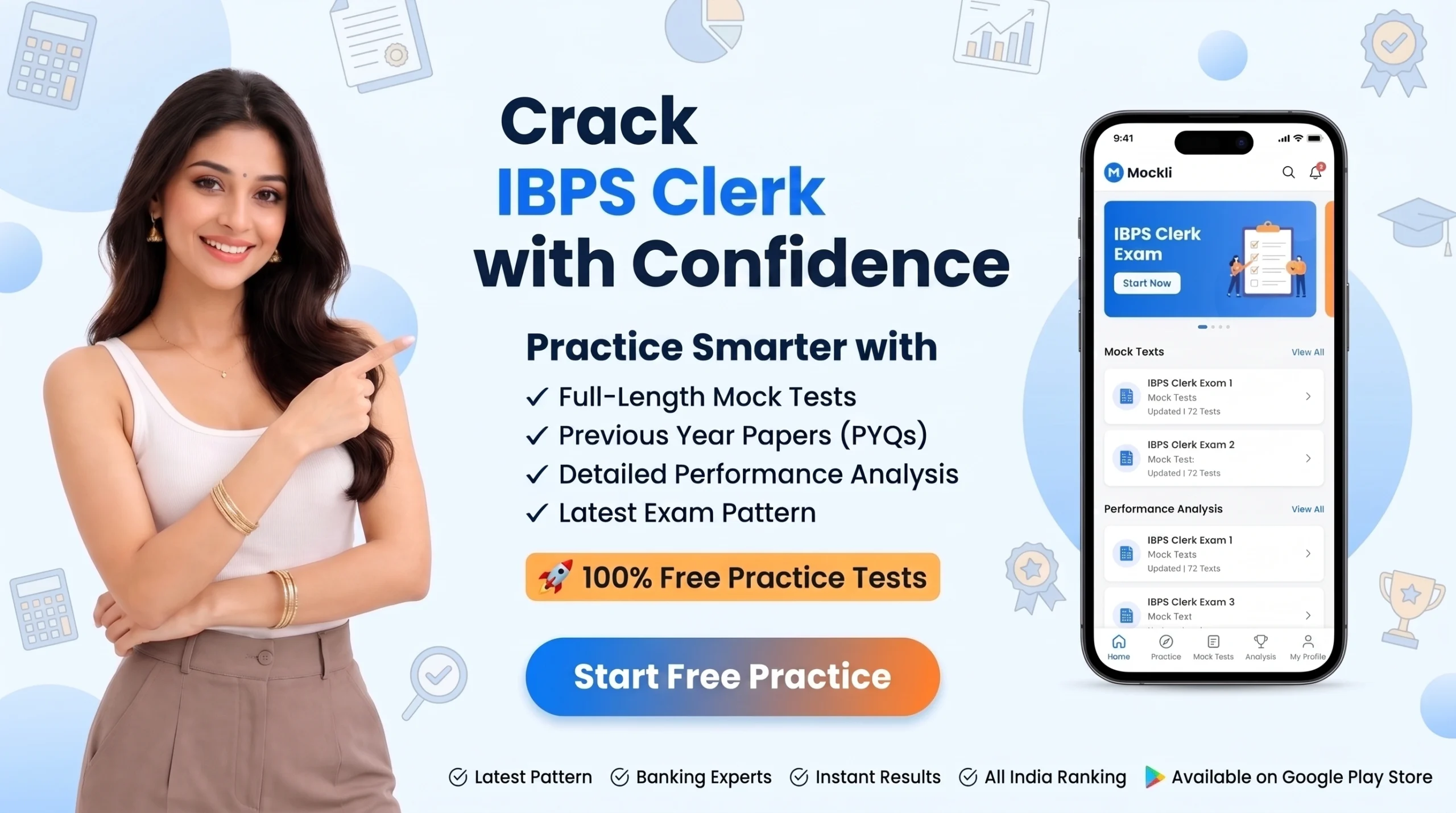
Mockli is built to give you exactly that. It is an all-in-one online government exam preparation platform that helps banking aspirants to prepare systematically through IBPS Clerk Mock Tests, Previous Year Papers, topic-wise practice tests, the IBPS Clerk Selection Process, and detailed performance analytics. Candidates not only prepare themselves, but also have a clear idea of their preparation level and where they need to work.
Whether you are preparing for the Preliminary Exam or aiming for a strong performance in the Main Exam, Mockli provides well-structured resources that help you gain confidence, improve accuracy, and consistently move closer to your target score.
The platform is designed to help aspirants to build concepts and practical exam skills that will help them to perform well in real exam conditions. Mockli helps candidates to learn smarter, not harder, by combining learning with continuous assessment.
How Mockli Supports Complete IBPS Clerk Preparation
Preparation for the IBPS Clerk Exam is a process that involves multiple steps, and each step requires a different approach to preparation. Mockli brings together all the important resources for preparation on one platform, so that the candidate does not have to refer to multiple websites or study materials. The platform supports candidates throughout their preparation journey by offering:
| Mockli Resource | How It Helps |
|---|---|
| IBPS Clerk Mock Tests | Simulate the real examination and improve speed, accuracy, and time management. |
| IBPS Clerk Previous Year Papers | Understand question trends and strengthen exam strategy. |
| Topic-wise Practice Tests | Improve concepts chapter by chapter. |
| Sectional Mock Tests | Strengthen individual subjects before attempting full-length exams. |
| Performance Analytics | Identify strengths, weak topics, and recurring mistakes. |
| Detailed Solutions | Learn the correct approach for every question. |
| Progress Tracking | Monitor improvement across multiple practice sessions. |
| Banking Mock Tests | Practise for multiple banking examinations using one platform. |
This comprehensive preparation ecosystem guarantees candidates a seamless transition from concept building to full exam readiness in an organized and efficient manner.
Why Regular Practice Matters More Than Predictions
Aspirants spend a lot of time searching for the expected IBPS Clerk Cut Off or trying to predict minimum marks required to get selected. Knowing the cut-off is helpful, but predictions should never be the center of your preparation strategy. The only thing you can control 100% is your own preparation.
Candidates who regularly revise, solve IBPS Clerk Previous Year Papers, and try Online IBPS Clerk Mock Tests regularly are generally much better prepared than those who depend on predicted cut-offs or expected score calculations.
Candidates should stop asking themselves “Will this score clear the cut-off?” and start asking themselves “How can I improve my score by another 10 or 15 marks? This attitude promotes continuous self-improvement and increases the chances of doing well, no matter how competitive the examination may be.
Smart Preparation Habits That Improve Your Score
All successful banking aspirants develop consistent study habits over time. These habits not only help to do better in the examination but also reduce the stress during the preparation. The following table highlights some of the most effective preparation practices.
| Good Preparation Habit | Long-Term Benefit |
|---|---|
| Follow the IBPS Clerk Syllabus systematically | Ensures complete coverage of important topics. |
| Understand the IBPS Clerk Exam Pattern | Builds familiarity with the examination structure. |
| Attempt regular IBPS Clerk Mock Tests | Improves exam temperament and confidence. |
| Solve IBPS Clerk Previous Year Papers | Understands actual question trends. |
| Revise weak topics consistently | Strengthens conceptual understanding. |
| Analyse every practice test | Prevents repeated mistakes. |
| Maintain an error notebook | Creates personalised revision material. |
| Track weekly progress | Keeps preparation organised and measurable. |
Those students who regularly follow these habits usually do better than students who study without a plan.
Frequently Asked Questions (FAQs)
1. What is the IBPS Clerk Cut Off?
IBPS Clerk Cut Off is the minimum marks required by a candidate to be shortlisted for the next stage of the selection process or to be eligible for final selection. It is determined by various factors like the difficulty level of the exam, number of candidates appearing, vacancies, and overall competition.
2. Does the IBPS Clerk Cut Off remain the same every year?
No. Many factors influence the cut-off, i.e, candidate performance, competition, vacancies, and the overall level of difficulty of the examination. So, the cut-off varies from recruitment to recruitment. Thus, the candidates need to aim for a competitive score rather than relying on the previous trends of cut-offs.
3. How can I score above the IBPS Clerk Cut Off?
The best way to prepare for IBPS Clerk is to complete the IBPS Clerk Syllabus, IBPS Clerk Eligibility, revise regularly, solve IBPS Clerk Previous Year Papers, and attempt frequent IBPS Clerk Mock Tests. Regular practice and detailed analysis of your performance can improve speed and accuracy and hence improve your chances of scoring well above the cut-off.
4. Is the Preliminary Examination cut-off different from the Main Examination cut-off?
Yes. There are two different stages in the recruitment process – Preliminary and Main Exams, and hence there are different cut-offs based on the competition and recruitment needs. The candidates should pay equal attention to both stages and not just one examination.
5. What factors influence the IBPS Clerk Cut Off?
The final cut-off will be decided keeping in mind various factors like overall difficulty level of the exam, number of candidates appearing, vacancies, state-wise competition, reservation policies for various categories and average performance of candidates.
6. Should I prepare according to the expected cut-off?
No. Preparing for the expected cut-off alone is risky as the benchmark keeps changing for every recruitment. It is always better to aim for a safe competitive score which is well above the expected qualifying level.
7. How important are mock tests for clearing the cut-off?
The best way to prepare is through IBPS Clerk Mock Tests. They are a great way to improve time management, increase accuracy, boost confidence, and help candidates to identify weak areas for further revision before the real examination.
8. Are previous year papers enough for IBPS Clerk preparation?
IBPS Clerk Previous Year Papers are very useful, but they must be used with the IBPS Clerk Syllabus, topic-wise practice, revision & regular mock tests. This balanced strategy ensures complete preparation and lets the candidates perform with confidence in the examination.
9. How can I measure whether my preparation is improving?
The best way to see improvement is to look at your performance on mock tests over time. Candidates should keep track of their accuracy, speed, section-wise scores, and recurring mistakes. An error notebook or preparation journal can also be useful to track your progress and see where you need to work more.
10. Why should I choose Mockli for IBPS Clerk preparation?
Mockli provides a one-stop preparation platform for aspirants, including free IBPS Clerk Mock Tests, IBPS Clerk Previous Year Papers, sectional tests, topic-wise quizzes, detailed solutions, IBPS Clerk Selection Process, and performance analytics. Mockli helps candidates build concepts, increase confidence, and prepare systematically for each stage of the IBPS Clerk recruitment process by combining exam-oriented practice with continuous performance tracking.
Government Exam Preparation With Mockli
IBPS Clerk Cut Off is an important parameter of the selection process, but it should not be the only focus of your IBPS Clerk Preparation. The cut-off score is determined by several dynamic factors, including competition, the difficulty of the paper, and the overall performance of the candidates. So, the best strategy is to aim for a score that is well above the expected benchmark. Regular practice, consistent revision, and strong concepts are far more likely to help candidates perform confidently throughout the recruitment process.
In a successful IBPS Clerk Preparation journey, you don’t just use one resource; you use multiple resources. Knowing the IBPS Clerk Syllabus, IBPS Clerk Eligibility, following the IBPS Clerk Exam Pattern, solving IBPS Clerk Previous Year Papers, and attempting Regular IBPS Clerk Mock Tests is a complete strategy that will boost your speed, accuracy, and temperament in the exam. Candidates who regularly analyse their mistakes, prepare well in all subjects, and study in a disciplined manner improve their performance continually and remain ahead of others irrespective of changes in cut-off.
If you want to score maximum marks & improve every aspect of your preparation, then Mockli is a complete learning ecosystem designed for banking aspirants. Mockli gives you complete IBPS Clerk Preparation with full-length online test series, previous year papers, sectional tests, topic-wise practice, Free IBPS Clerk Mock Tests, and detailed performance analysis to prepare you confidently and efficiently. With the right guidance, smart study, and consistent practice, you can build a strong score that takes you far above the IBPS Clerk Cut Off and closer to your goal of a flourishing career in the banking sector.